Blind Spot Truck Accidents in Manchester: How to Prove Negligence in Court
Hurt in a blind spot truck accidents in Manchester? See how negligence is proven in court, what evidence matters, and who can be held liable.
Blind spot truck accidents are some of the most frightening crashes that happen on Manchester roads. One second you are driving next to an 18-wheeler on I-293 or the Everett Turnpike, and the next, the truck is drifting into your lane as if you were not there. For the truck driver, you often were not there, at least not in the mirrors. A loaded tractor-trailer has large zones around it where a passenger car simply disappears from view.
Here is the part many injured drivers get wrong: a blind spot is not an excuse. Truck drivers are trained professionals, and federal and state rules expect them to know exactly where their blind spots are and to check them before turning, merging, or backing up. When they fail to do that, it is usually truck driver negligence, and the law gives you a way to hold them and their employer responsible.
Proving that in court takes more than your word against theirs. You need evidence, a clear legal theory, and an understanding of how trucking companies and their insurers fight these claims. This guide walks through how blind spot truck accidents in Manchester happen, the four elements of negligence, the evidence that wins cases, who can be liable, and the steps to take right after a crash so your truck accident claim stays strong from day one.
What Is a Truck Blind Spot? Understanding the “No-Zones”
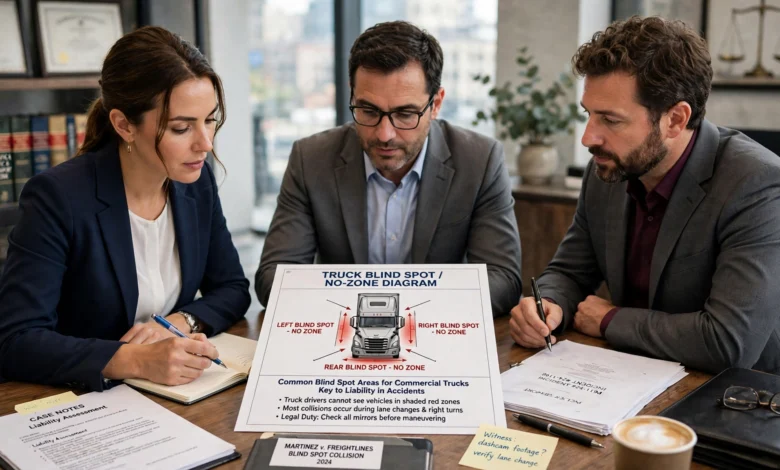
Every vehicle has blind spots, but a commercial truck’s are in a different league. The driver sits high up, the trailer can stretch 53 feet behind the cab, and there is no rear window to glance through. The result is four large areas where a car can vanish completely. Safety regulators call these the no-zones, and they sit at the center of almost every truck blind spot accident case.
The Federal Motor Carrier Safety Administration has spent decades warning drivers about these areas through its Our Roads, Our Safety tips for driving around large trucks. Knowing where they are helps you understand what the truck driver could and could not see, which is the first question in any negligence case.
The Four Truck No-Zones
- Front no-zone. The long hood and high seat hide roughly the first 20 feet in front of the bumper. A car that merges in too close can disappear, and the truck may not be able to stop in time.
- Rear no-zone. There is a blind area of about 30 feet directly behind the trailer. A truck backing into a loading dock or stopping suddenly is a common source of rear blind spot crashes.
- Left-side no-zone. This runs along the driver’s side, usually from just behind the cab door to about the middle of the trailer.
- Right-side no-zone. This is the biggest and most dangerous one. It can cover the full length of the trailer and extend across one or even two lanes. Most semi truck lane change accidents happen here.
A Blind Spot Is Not a Legal Excuse
This is the point that matters most for your case. Truck drivers know their blind spots exist. They are trained on them when they earn a commercial driver’s license, and the vehicles are fitted with mirrors that, when properly adjusted and actually used, cover a lot of that space. A trucker who says “I never saw the car” is often admitting that he did not check, did not wait, or did not adjust his mirrors. That is the heart of proving negligence in a truck accident caused by a blind spot.
Why Blind Spot Truck Accidents Happen in Manchester
Manchester is New Hampshire’s largest city and a freight crossroads. Trucks feed in from I-93, I-293, the F.E. Everett Turnpike, and Route 101, then work their way through busy commercial corridors like South Willow Street, Elm Street, and the roads around the Manchester-Boston Regional Airport. That mix of highway merges, tight downtown turns, and heavy retail traffic creates the exact conditions where blind spot truck accidents happen most.
Common Blind Spot Crash Scenarios
- Unsafe lane changes on the highway. A truck moves right to reach an exit on I-293 and sideswipes a car sitting in its right-side no-zone. These sideswipe truck accidents often push the car off the road or into a guardrail.
- Merging at on-ramps. When a truck merges onto I-93 without checking its left mirror, a car already in the travel lane can get squeezed.
- Wide right turns in the city. Trucks swing left before turning right. A car or cyclist that slides into the gap on the right gets trapped. These right turn truck accidents are common at downtown intersections.
- Backing up at loading docks. Delivery trucks reversing into retail lots and warehouses can strike vehicles or pedestrians in the rear no-zone.
- Pulling away from a stop. A driver who starts moving from a light without checking the front no-zone can roll right into a small car stopped close to the bumper.
Factors That Make These Crashes Worse
Blind spots are a fixed feature of the truck. What turns them into crashes is usually human behavior. The most common contributing factors include:
- Driver fatigue from long hours, which slows mirror checks and reaction time
- Distracted driving, such as using a phone or dispatch screen
- Mirrors that are cracked, loose, or badly adjusted
- Rushing to meet delivery windows
- Poor training on lane-change and turning procedures
- Winter conditions, since New Hampshire snow and road spray can coat mirrors and cameras
How Negligence Works in Blind Spot Truck Accident Cases
Negligence is the legal theory behind nearly every truck accident lawsuit. In plain terms, it means someone failed to act with reasonable care and you got hurt because of it. To win in a New Hampshire court, you and your attorney have to prove four elements.
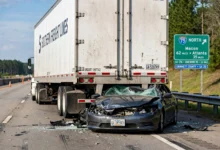

The Four Elements of Negligence
- Duty of care. Every driver owes others on the road a duty to drive safely. Commercial truck drivers carry a higher practical standard because they are trained professionals operating an 80,000-pound vehicle under federal safety rules.
- Breach of duty. You have to show the driver fell short. In a blind spot case, the breach is usually changing lanes, turning, merging, or backing up without making sure the space was clear.
- Causation. The breach has to be the actual cause of the crash and your injuries. If the truck’s lane change is what put it into your car, causation is often straightforward.
- Damages. You must have real losses, such as medical bills, lost wages, vehicle damage, or pain and suffering.
How New Hampshire’s Comparative Fault Rule Affects Your Case
New Hampshire follows a modified comparative fault rule under RSA 507:7-d. You can still recover money as long as your share of fault is not greater than the fault of the defendants. Your award is then reduced by your percentage of fault. If you are found 20 percent at fault on a $200,000 claim, you would recover $160,000. If a jury decides you were more at fault than the truck driver, you recover nothing.
This is why trucking insurers work so hard to argue that you were “lingering in the blind spot.” Every point of fault they shift onto you lowers what they pay. Strong evidence about what the truck driver did, and failed to do, is your best defense against that tactic.
Federal Trucking Rules as Proof of Breach
Truck drivers must follow the Federal Motor Carrier Safety Regulations on top of New Hampshire traffic law. Violations of these rules can be powerful evidence that the driver or company breached their duty. Key rules in blind spot truck accident cases include:
- Mirror requirements for commercial vehicles
- Hours of service limits that prevent fatigued driving
- Inspection and maintenance requirements for safety equipment
- Driver qualification and training standards
When a driver broke one of these rules and that violation helped cause the crash, it becomes much easier to show a breach of duty in court.
7 Proven Ways to Prove Negligence in Blind Spot Truck Accidents
Winning a blind spot truck accident claim comes down to evidence. Trucking companies often send investigators to the scene within hours, so your side needs to move just as fast. These are the seven types of evidence that carry the most weight in Manchester cases.
1. Electronic Logging Device and Black Box Data
Most commercial trucks carry an electronic logging device (ELD) and an engine control module, often called the black box. Together they can show the truck’s speed, braking, steering input, and turn signal use in the seconds before impact. They also record how long the driver had been on duty. If the data shows the driver was past legal limits, that supports a fatigue argument. The Congressional Research Service report on hours of service and the ELD mandate explains how these limits and devices work.
This data can be overwritten, so your lawyer should send a spoliation letter right away demanding that the company preserve it.
2. Dashcam and Surveillance Footage
Many fleets now run forward-facing and driver-facing cameras. That footage can show whether the driver checked mirrors, looked at a phone, or signaled before moving over. Nearby businesses on busy Manchester roads, traffic cameras, and other drivers’ dashcams can fill in the gaps.
3. Accident Reconstruction
An accident reconstruction expert uses vehicle damage, skid marks, final resting positions, and data from the truck to rebuild the crash. In a blind spot case, the expert can show how long your car was beside the truck, whether it was visible in a properly adjusted mirror, and whether the driver had time to see you before moving.
4. Mirror and Equipment Inspection
If the truck’s mirrors were missing, cracked, or misaligned, or if a camera or blind spot sensor was broken, that is direct evidence of negligence. An inspection of the truck soon after the crash, along with its maintenance and inspection records, can reveal whether the company kept its safety equipment in working order.
5. Police Report and Witness Statements
The crash report from the Manchester Police Department or New Hampshire State Police records the scene, any citations, and initial statements. Independent witnesses are especially valuable because they have no stake in the outcome. A witness who says “the truck just moved over without signaling” can carry a lot of weight with a jury.
6. Driver Qualification and Employment Records
Trucking companies must keep a qualification file on every driver. These records can show a history of crashes, failed drug tests, past violations, or a lack of training. If a company hired or kept an unsafe driver, it may be liable for negligent hiring or supervision.
7. Cell Phone and Dispatch Records
Phone records can show whether the driver was texting or on a call at the moment of the crash. Dispatch messages can reveal pressure to meet tight delivery deadlines. Both help explain why a professional driver skipped the basic step of checking a blind spot.
| Evidence type | What it can prove | Why speed matters |
|---|---|---|
| ELD and black box data | Speed, braking, signals, hours driven | Can be overwritten within days or weeks |
| Dashcam and video | Mirror checks, distraction, signal use | Businesses often delete footage quickly |
| Accident reconstruction | Positions, visibility, timing | Scene evidence fades fast |
| Mirror inspection | Equipment failure or poor maintenance | Trucks get repaired and returned to service |
| Police report and witnesses | Fault, citations, independent accounts | Memories fade over time |
| Driver files | Unsafe history, poor training | Must be requested in discovery |
| Phone and dispatch logs | Distraction, schedule pressure | Usually requires a subpoena |
Who Can Be Held Liable in Blind Spot Truck Accidents?
One of the biggest differences between a car crash and a truck crash is the number of parties who may share the blame. Naming every responsible party matters, because it opens more insurance coverage and makes a full recovery more likely.
The Truck Driver
The driver is the most obvious defendant. If they changed lanes, turned, or backed up without checking their mirrors, they are directly responsible for that choice.
The Trucking Company
Under a legal rule called vicarious liability, employers are generally responsible for the negligence of their employees while on the job. Trucking companies can also be directly liable for their own failures, such as:
- Hiring drivers with poor safety records
- Failing to train drivers on blind spot procedures
- Pushing schedules that encourage drivers to break hours of service rules
- Skipping required inspections and repairs
Companies sometimes try to avoid liability by labeling drivers as independent contractors. A good Manchester truck accident lawyer will look at the actual working relationship, the operating authority on the truck, and the lease agreements to find who is truly responsible.
Maintenance Contractors
If an outside shop serviced the truck and failed to fix broken mirrors, cameras, or turn signals, that shop may share the blame.
Manufacturers
When a defective mirror bracket, camera system, or blind spot warning sensor fails, the manufacturer may face a product liability claim alongside the negligence case.
Cargo Loaders and Shippers
Less common in blind spot cases, but still possible. Cargo that sticks out past the trailer or blocks mirror views can create new blind areas, and the party that loaded it may be partly at fault.
Common Defenses in Blind Spot Truck Accidents and How to Beat Them
Trucking companies and their insurers have a playbook for these cases. Knowing what they will argue helps you prepare.
“The Car Was Lingering in the Blind Spot”
This is the most common defense. The insurer argues that you should have known better than to drive alongside a truck. The answer is that being in a blind spot does not give a truck driver permission to move into you. Drivers must confirm the lane is clear before changing it. ELD data, video, and reconstruction can show how briefly you were there, or that you were visible in a properly adjusted mirror.
“The Car Cut In Front of the Truck”
Sometimes the defense claims you merged too close in the front no-zone. Black box data showing the truck’s speed and following distance can test that story. If the truck was speeding or following too closely, the driver still shares fault.
“Nobody Could Have Seen That Car”
This argument treats the blind spot as an act of nature. It is not. Mirror systems, convex mirrors, cameras, and simple practices like signaling early and moving slowly all exist to manage the blind spot. A driver who skipped them cannot hide behind it.
“Your Injuries Were Not Caused by the Crash”
Insurers often dispute the medical side, especially with neck, back, or brain injuries. Prompt medical care, consistent treatment, and clear records linking your injuries to the crash are the best response.
How a Truck Accident Attorney Builds the Counterargument
- Locks down evidence before it disappears
- Hires reconstruction and medical experts
- Uses federal safety rules to set the standard of care
- Takes depositions of the driver, safety managers, and dispatchers
- Prepares the case for trial, which often leads to fairer settlement offers
What to Do After Blind Spot Truck Accidents in Manchester
The steps you take in the first days after a crash can make or break your case. If you are able, try to follow this order.
Steps to Protect Your Claim
- Call 911 and get medical care. Your health comes first. Some injuries, like concussions and internal bleeding, do not show symptoms right away.
- Document the scene. Take photos of all vehicles, the truck’s mirrors, the road, skid marks, and any signs or signals.
- Collect key details. Write down the truck’s company name, USDOT number, plate number, and the driver’s information.
- Get witness contacts. Names and phone numbers of anyone who saw the crash are valuable.
- Do not give a recorded statement. The trucking company’s insurer may call quickly. Politely decline until you have legal advice.
- Keep every record. Save medical bills, receipts, repair estimates, and notes about missed work.
- Talk to a truck accident attorney early. A lawyer can send preservation letters before critical data is erased.
Deadlines for Filing a Truck Accident Lawsuit in New Hampshire
Under RSA 508:4, most personal injury claims in New Hampshire must be filed within three years of the crash. Claims against a city or state agency can come with much shorter notice deadlines, sometimes measured in days. Waiting also lets evidence slip away, so it is smart to act long before the deadline.
Compensation Available After a Truck Accident
If you prove negligence, you may be able to recover:
- Past and future medical expenses
- Lost wages and reduced earning capacity
- Pain and suffering
- Emotional distress and loss of enjoyment of life
- Property damage to your vehicle
- Wrongful death damages for families who lost a loved one
New Hampshire does not allow traditional punitive damages, but courts can award enhanced compensatory damages when conduct was wanton, malicious, or oppressive. Serious truck accident injuries like spinal cord damage, traumatic brain injuries, and amputations often lead to larger awards because their costs last a lifetime.
Conclusion
Blind spot truck accidents in Manchester are not simply bad luck or the unavoidable result of driving near a big rig. Truck drivers know where their no-zones are, and the law expects them to check mirrors, signal, and wait before turning, merging, or backing up. When they skip those steps, you can prove negligence by showing a duty of care, a clear breach, a direct link to the crash, and real damages, backed by ELD and black box data, video, accident reconstruction, equipment inspections, witness accounts, driver records, and phone logs.
New Hampshire’s comparative fault rule means insurers will try to shift blame onto you, so acting fast to preserve evidence and getting help from an experienced Manchester truck accident lawyer well within the three-year filing window gives you the strongest chance of holding the driver and trucking company accountable and recovering full compensation.