Underride Truck Accidents in Georgia: The Deadliest Collisions and Legal Options
Underride truck accidents in Georgia often turn fatal. See why these crashes happen, who can be held liable, and the legal options open to victims.
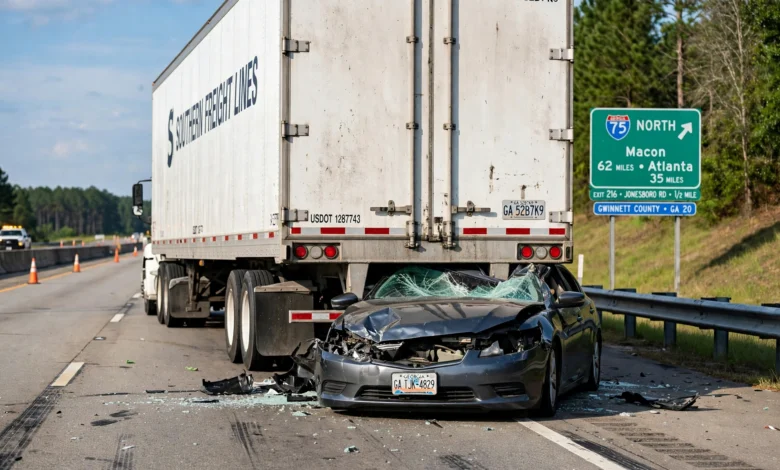
Underride truck accidents in Georgia are among the most violent crashes that can happen on a highway. In an underride crash, a car slides beneath the trailer of a tractor-trailer instead of hitting something that stops it. The trailer bed sits at about the height of a passenger’s head, so the part of the car built to absorb a crash never touches anything. The windshield and roof take the hit instead.
Georgia sees a heavy share of big-rig traffic. Freight moves through Atlanta on I-75, I-85, and I-285, and trucks run between the Port of Savannah and the rest of the Southeast on I-16 and I-95. More trucks on the road means more chances for a car to end up under a trailer, especially at night, in rain, or when a truck is turning or stopped on the shoulder.
What makes these cases different from an ordinary fender bender is the number of people who might share the blame. The truck driver, the trucking company, a maintenance shop, and even the company that built the trailer or its underride guard can all play a part.
This guide walks through how a truck underride crash happens, why it is so deadly, what federal safety rules say, and what Georgia law allows victims and families to recover. It also covers deadlines and the first steps worth taking after a crash.
What Are Underride Truck Accidents in Georgia?
An underride accident happens when a smaller vehicle goes partly or fully under the body of a large truck. Most involve semitrailers, but box trucks, dump trucks, and flatbeds can cause them too. The gap between the road and the bottom of a trailer is usually wide enough for the front of a sedan or small SUV to pass through.
Override crashes are the reverse, where a truck rides up over a smaller vehicle. Both are deadly, but underride crashes get special attention because a working guard can often prevent them.
Rear Underride Crashes
A rear underride crash happens when a car hits the back of a trailer. Federal rules require most trailers to carry a rear impact guard, the metal bar that hangs below the back doors. When the guard is strong, properly mounted, and in good repair, it can stop a car before the trailer bed reaches the windshield.
The trouble is that many guards bend, snap off at the welds, or rust through. Crash testing by the Insurance Institute for Highway Safety has shown that even guards meeting older federal standards can fail when a car hits only one corner of the trailer.
Side Underride Crashes
A side underride crash happens when a car hits the long side of a trailer. This often occurs when a truck makes a wide turn, pulls out of a driveway, backs across a road, or crosses an intersection at night. There is no federal rule requiring a side underride guard in the United States, so most of that open space is unprotected.


IIHS engineers have said side underride is actually more common than rear underride in fatal crashes. That surprises a lot of people, since the debate tends to focus on rear guards.
Front Underride Crashes
Front underride is less common. It happens in head-on crashes when a car slides under the front bumper of a truck. Europe requires front protection on many heavy trucks, but the United States does not.
Why Underride Truck Accidents in Georgia Are So Deadly
Modern cars are built around a simple idea. The front end crumples, the airbags deploy, and the cabin stays intact. Underride truck accidents in Georgia break every part of that plan.
Here is why these crashes are so often fatal:
- The crumple zone never engages. The bumper and hood pass under the trailer, so the engineered parts of the car do not absorb any energy.
- Airbag sensors may not trigger in time. Sensors are tuned to detect a front-end impact. If the first real contact is the windshield pillar, the airbag can deploy late or not at all.
- The trailer hits at head height. The trailer bed strikes the windshield and roof, which puts the driver and front passenger directly in its path.
- Passenger compartment intrusion. The roof can be sheared off or crushed down into the seats. This is often called “passenger compartment intrusion” in crash reports.
- Small cars are most exposed. Sedans, coupes, and compact SUVs sit low enough to slide farther under than a pickup or large SUV.
Common Catastrophic Injuries
Survivors of a truck underride crash often face catastrophic injuries that change their lives for good. Common examples include:
- Traumatic brain injury, ranging from severe concussion to permanent cognitive damage
- Decapitation or near decapitation, which is tragically common in high-speed underride crashes
- Spinal cord injuries, including paralysis
- Facial and skull fractures
- Crush injuries to the chest, neck, and upper body
Families in these cases are often dealing with a funeral, not a recovery. That is why a wrongful death claim is a central part of many underride cases.
Underride Crash Statistics: What the Numbers Show
Hard numbers on underride deaths are surprisingly difficult to pin down. Federal crash databases do not always record whether a car went under a truck, and responding officers may not note it in the report. Safety researchers agree the official counts are likely too low.
Here is what the available research tells us:
- IIHS data for 2015 showed 301 deaths in two-vehicle crashes where a passenger vehicle struck the side of a tractor-trailer, and 292 deaths where it struck the rear.
- IIHS has estimated that underride plays a role in about half of fatal side crashes, which works out to roughly 150 deaths a year from side underride alone.
- A 2012 IIHS study found that strong side guards could lower injury risk in about three out of four serious side crashes with large trucks, and closer to 90 percent when the truck was a semitrailer.
- An analysis by IIHS researcher Matthew Brumbelow projected that a national side guard rule could prevent roughly 159 to 217 deaths per year.
These figures are national, but they matter for Georgia. The state sits on some of the busiest freight corridors in the country, so a meaningful share of these crashes happens on Georgia roads.
Common Causes of Underride Truck Accidents in Georgia
Most underride crashes are not pure accidents. They usually trace back to a decision or a shortcut by someone in the trucking chain. Knowing the cause matters because it points to who is legally responsible.
Poor Visibility and Missing Reflective Tape
Trailers are required to carry reflective tape and working lights so drivers can see them at night. When tape is faded, dirty, or missing, a dark trailer stretched across a road can be almost invisible until it is too late to brake. Burned-out tail lights and marker lights cause the same problem.
Unsafe Turns and Crossing Maneuvers
A truck making a wide right turn, a U-turn, or a slow crossing at an unsignaled intersection can block every lane for several seconds. If the driver misjudges the gap in traffic, an oncoming car may have nowhere to go but under the side of the trailer. These crashes are common on rural Georgia highways and near warehouses and distribution centers.
Sudden Stops and Illegal Parking
Trucks parked on the shoulder without hazard lights or warning triangles are a known danger. So are trucks that stop short in traffic or slow sharply on an interstate ramp. Federal rules require drivers to set out warning devices when a truck is stopped on the road for any length of time.
Damaged or Defective Underride Guards
A rear impact guard that is bent, cracked, rusted, or held on with weak welds may collapse on impact. Some guards are poorly designed from the start. Others were damaged in an earlier crash and never repaired.
Driver Fatigue and Distraction
Hours of service rules limit how long a truck driver can be on the road. Tired drivers make slower decisions and are more likely to stop abruptly or turn without checking traffic. Phone use and in-cab screens add to the risk.
Other Common Factors
- Speeding or following too closely by either vehicle
- Poor weather, including heavy rain and fog
- Bad road lighting at intersections and exits
- Improperly loaded cargo that affects braking and handling
Federal Regulations on Underride Guards
Federal law shapes what a trailer must carry and how it must be maintained. These rules often become the backbone of a negligence case.
Rear Impact Guard Standards
Two federal safety standards, FMVSS No. 223 and FMVSS No. 224, cover rear impact guards on trailers and semitrailers weighing 10,000 pounds or more. In July 2022, NHTSA published a final rule raising the required crash protection so guards must protect people in compact and subcompact cars hitting the rear of a trailer at 35 mph, up from 30 mph. That rule took effect for new trailers on July 15, 2024. You can read the full text in the NHTSA rear impact guard final rule in the Federal Register.
Safety advocates argued the update did not go far enough because it does not test offset crashes, where a car hits only part of the guard. In 2024, NHTSA denied petitions asking it to add a 30 percent overlap test at 35 mph.
No Federal Side Guard Requirement
There is still no federal rule requiring side underride guards on trailers. Bills such as the Stop Underrides Act have been introduced in Congress more than once. Some trailer makers and fleets have installed side guards voluntarily, but most trailers on Georgia roads do not have them.
FMCSA Inspection and Maintenance Rules
The Federal Motor Carrier Safety Administration (FMCSA) requires motor carriers to inspect, repair, and maintain their equipment, including rear impact guards, lights, and reflective tape. Trucks must pass periodic inspections, and drivers must complete inspection reports. When a carrier skips those steps, the paper trail can show it, which is why records are so valuable in an underride accident claim.
Who Is Liable in Underride Truck Accidents in Georgia?
One of the biggest differences between a truck case and a car case is the number of possible defendants. In many underride truck accidents in Georgia, more than one party carries part of the blame.
The Truck Driver
The driver may be at fault for an unsafe turn, illegal parking, failing to set out warning triangles, speeding, or driving while fatigued or distracted. Driver logs, electronic logging device data, and phone records often tell the story.
The Trucking Company
Under Georgia law, an employer is generally responsible for the negligence of an employee acting within the scope of the job. Beyond that, trucking company liability can rest on the company’s own failures, such as:
- Hiring a driver with a poor safety record
- Failing to train drivers on turns, parking, and night driving
- Pushing schedules that encourage drivers to break hours of service rules
- Skipping inspections or putting off repairs to guards, lights, and tape
Maintenance and Repair Shops
If a third-party shop was responsible for inspecting or repairing the trailer and missed a damaged guard or failed lights, that shop may share responsibility.
The Trailer or Guard Manufacturer
When a guard fails because of a design or manufacturing flaw, the trailer manufacturer or the company that made the guard may face a product liability claim. Georgia generally limits these claims with a 10-year statute of repose that runs from when the product was first sold, though there are exceptions. Product cases need engineering experts and early inspection of the trailer, so they are worth raising quickly.
Cargo Loaders and Shippers
A company that overloaded or improperly loaded a trailer can be partly at fault if the load affected how the truck stopped or turned.
Government Agencies
In rare cases, poor road design, missing signs, or broken intersection lighting contributes to a crash. Claims against the state, a county, or a city come with special notice rules and much shorter deadlines, so they need attention right away.
Georgia Laws That Affect Your Underride Accident Claim
Georgia has several rules that shape how a Georgia truck accident case plays out. A few are especially important in underride cases.
Statute of Limitations
In most cases, Georgia gives you two years from the date of the crash to file a personal injury lawsuit under O.C.G.A. § 9-3-33. A wrongful death claim generally must be filed within two years of the date of death. Some exceptions can pause or shorten that clock, and claims against government bodies require written notice much sooner. Waiting is risky because key evidence can disappear long before the deadline.
Modified Comparative Negligence
Georgia follows a modified comparative negligence rule under O.C.G.A. § 51-12-33. If you are found partly at fault, your damages are reduced by your share. If you are found 50 percent or more at fault, you cannot recover anything. Trucking companies often argue that the car driver was speeding or not paying attention, so this rule comes up in almost every underride accident case.
The 2025 Tort Reform Changes (SB 68)
Georgia passed a major tort reform law, Senate Bill 68, which Governor Brian Kemp signed on April 21, 2025. Several changes matter for truck crash victims:
- Seat belt evidence. Juries can now hear whether an injured person was wearing a seat belt, and it can be used on fault and damages. A judge can still exclude it if it would be unfairly prejudicial.
- Medical bill evidence. Juries can see both the amount billed and the amount actually paid for medical care, which can lower the medical damages awarded.
- Limits on anchoring. Lawyers face new limits on suggesting specific dollar figures for pain and suffering.
- Split trials. Either side can ask that fault and damages be tried in separate phases.
The overview of Georgia’s SB 68 from Kennedys Law lays out these changes in more detail. Some provisions apply only to claims arising after the effective date, so the timing of your crash matters.
Direct Action Against the Carrier’s Insurer
Georgia is one of a small number of states that, in certain cases, allows an injured person to name a motor carrier’s insurance company directly in the lawsuit. Whether this applies depends on the carrier’s registration and the facts of the crash, but it can be a useful tool.
Damages Available After an Underride Truck Crash
The goal of a civil claim is to put a dollar value on everything the crash took from you or your family. Because these crashes are so severe, damages are often substantial.
Economic Damages
- Past and future medical bills, including surgery, rehab, and long-term care
- Lost wages and lost earning capacity
- Home modifications and medical equipment
- Vehicle damage and other property losses
- Funeral and burial costs in fatal crashes
Non-Economic Damages
- Physical pain and suffering
- Emotional distress and mental anguish
- Disfigurement and permanent disability
- Loss of enjoyment of life
Wrongful Death Damages
Georgia measures wrongful death damages by the full value of the life of the person who died, as seen from that person’s point of view. This includes both the economic value, such as lost earnings, and the intangible value of the life itself. A spouse, children, or parents usually bring this claim, depending on who survives. A separate estate claim can cover medical and funeral costs and any pain the person experienced before death.
Punitive Damages
When a trucking company acted with willful misconduct or a conscious disregard for safety, such as knowingly sending a truck out with a broken guard, a jury may award punitive damages. Georgia caps most punitive awards at $250,000, but the cap does not apply in some cases, including those involving intent to harm or impairment from alcohol or drugs.
What to Do After an Underride Accident in Georgia
The steps you take in the first days and weeks can make a real difference. Here is a practical checklist:
- Get medical care right away. Some injuries, especially brain injuries, are not obvious at first. Medical records also link your injuries to the crash.
- Call 911 and get a police report. Ask that the report note the underride and the condition of the guard, lights, and tape if possible.
- Photograph everything. Take photos of both vehicles, the trailer’s rear or side, the guard, the road, skid marks, and lighting conditions.
- Collect witness information. Names and phone numbers of anyone who saw the crash can be hard to track down later.
- Avoid recorded statements. Do not give a recorded statement to the trucking company’s insurer before getting legal advice.
- Preserve the evidence. The trailer, its guard, the black box data, and driver logs can be repaired, overwritten, or destroyed. A spoliation letter sent early demands that the company keep them.
- Talk to a Georgia truck accident lawyer. A lawyer who handles underride cases can bring in reconstruction and engineering experts and deal with multiple insurers.
Why Evidence Disappears Fast
Trucking companies often send their own response teams to a serious crash within hours. A damaged trailer can be repaired and back on the road within weeks. Electronic data may be overwritten on a schedule. Acting quickly is often the only way to keep the proof that a guard failed or a driver broke the rules.
How a Georgia Truck Accident Lawyer Can Help
An underride case is technical and usually well defended. A lawyer with truck accident experience typically handles several jobs at once:
- Investigating the crash and hiring reconstruction experts
- Inspecting the trailer and guard with engineers
- Requesting driver logs, maintenance files, and electronic data
- Identifying every liable party and every insurance policy
- Calculating full damages, including future care and lost earnings
- Negotiating with insurers and taking the case to trial when needed
Most personal injury lawyers in Georgia work on a contingency fee, which means they are paid only if they recover money for you. This guide is general information, not legal advice. Every crash is different, and a lawyer licensed in Georgia can tell you how the law applies to your situation.
Conclusion
Underride truck accidents in Georgia are some of the deadliest crashes on the road because they bypass the safety features that normally protect people inside a car, sending the trailer straight into the windshield and roof. They usually trace back to preventable problems like missing reflective tape, unsafe turns, illegally parked trucks, worn or weak underride guards, and tired or distracted drivers, and federal rules still leave the sides of most trailers unprotected. Georgia law gives injured people and grieving families real options, including claims against the driver, the trucking company, maintenance shops, and manufacturers, with damages for medical costs, lost income, pain and suffering, the full value of a lost life, and sometimes punitive damages.
Those rights come with a two-year deadline, a 50 percent fault bar, and new 2025 tort reform rules, so getting medical care, preserving evidence, and speaking with an experienced Georgia truck accident lawyer early can make all the difference.Sources