Premises Liability Claims in Melbourne: When Property Owners Are Responsible
Premises liability claims in Melbourne explained: when property owners owe a duty of care, what counts as negligence, and how to claim.
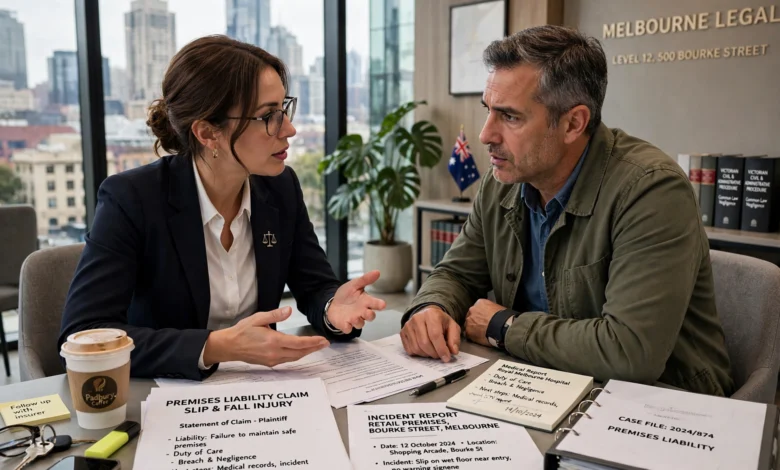
Premises liability claims in Melbourne come up more often than most people expect. A cracked footpath outside a cafe, a wet supermarket floor with no warning sign, a loose stair rail at an apartment block — these everyday hazards send people to Melbourne hospitals every week, and many of those injuries were entirely preventable. When a property is poorly maintained or a hazard is left unaddressed, the person who controls that space can end up legally and financially responsible for what happens there.
In Victoria, this area of law is technically called occupiers’ liability, though most people still refer to it by the more familiar term, premises liability, or simply a public liability claim. Whatever name you use, the underlying question is the same: did the person in control of the property take reasonable care to keep it safe, and if not, did that failure cause someone’s injury?
This isn’t a niche legal issue. It touches shopping centres, rental properties, gyms, licensed venues, construction sites, and even private homes. If you’ve been hurt on someone else’s property in Melbourne, understanding how these claims work, who can be held liable, and what you need to prove will make a real difference in whether you get fair compensation. This article walks through the legal framework, the categories of visitors the law recognises, common hazards that lead to claims, and the practical steps involved in bringing one forward.
1. What Premises Liability Actually Means in Melbourne
At its core, premises liability is about duty of care. If you own, lease, manage, or otherwise control a property, the law expects you to take reasonable steps to prevent people from being hurt while they’re on it. This applies whether the visitor is a paying customer, a tradesperson, a friend dropping by, or even someone who wandered in uninvited.
In Victoria, this obligation is set out in Part IIA of the Wrongs Act 1958, along with decades of common law developed through court decisions. The Act was introduced through the Occupiers’ Liability Act 1983, which folded a single statutory duty of care into the Wrongs Act rather than leaving it to older common law categories. You can read the underlying statutory history and case commentary in this <a href=”https://classic.austlii.edu.au/au/journals/MelbULawRw/2015/18.html” target=”_blank” rel=”noopener noreferrer”>Melbourne University Law Review analysis of occupiers’ liability legislation</a>.
The key point is this: liability doesn’t automatically fall on whoever owns the title to the land. It falls on the occupier — the person or business with control over the premises at the time of the incident. That distinction matters a lot in Melbourne, where so much retail and commercial property is leased.
2. Who Counts as an “Occupier” Under Victorian Law
This is where a lot of confusion happens, especially when a claim involves a landlord and a tenant business.
An occupier is generally the person or entity with practical control over a space, meaning they can decide who enters, how the space is used, and what maintenance happens. In many everyday situations:
- A retail tenant running a store is usually the occupier of the shop floor, even if a separate landlord owns the building.
- A landlord typically remains responsible for structural elements, common areas, and anything outside the tenant’s control, such as a shared stairwell or car park.
- A body corporate is often the occupier of common property in an apartment complex, while individual owners are responsible for their own units.
- A homeowner is the occupier of their own house and yard, including for social guests and tradespeople.
Because more than one party can be an occupier of different parts of the same site, it’s common for a property owner and a business operator to both be named in a claim, with liability apportioned between them depending on who controlled the specific area where the injury occurred.


3. The Standard of Care Owed to Visitors
Under the Wrongs Act, an occupier owes a duty to take reasonable care to ensure that people on the premises are not injured because of the state of the property. This is a single, unified standard that applies broadly, regardless of whether the visitor is there for business or purely social reasons — though the specific circumstances of the visit still shape what “reasonable” looks like in practice.
Courts weigh a number of factors when deciding whether an occupier met this standard, including:
- The likelihood that the hazard would cause harm, and how serious that harm might be
- Whether the occupier knew, or should have known, about the danger
- How much it would have cost, in time and money, to fix or warn about the hazard
- Whether the visitor’s own conduct contributed to what happened
- The nature of the premises and the purpose for which the visitor was there
This is a negligence-based test, not a rule of strict liability. A property owner isn’t automatically at fault every time someone gets hurt — the injured person has to show the occupier fell below what a reasonable person in their position would have done.
3.1 What “Reasonable Care” Looks Like Day to Day
For most Melbourne businesses and homeowners, meeting this standard comes down to fairly ordinary housekeeping:
- Inspecting the property regularly for hazards such as loose tiles, damaged flooring, or broken fixtures
- Cleaning up spills promptly and placing visible warning signs while doing so
- Repairing known defects within a reasonable timeframe rather than leaving them indefinitely
- Providing adequate lighting in stairwells, car parks, and walkways
- Keeping fire exits, handrails, and safety equipment in working order
- Warning visitors of hazards that can’t be immediately removed, such as wet paint or uneven ground during renovations
4. Common Situations That Lead to Premises Liability Claims
Melbourne’s mix of older buildings, busy retail strips, and high-density apartment living creates plenty of scenarios where these claims arise. Some of the most frequent include:
- Slip and fall incidents — wet floors in supermarkets, spilled drinks in bars, or freshly mopped areas without signage.
- Trip hazards — uneven pavement, torn carpet, loose cables, or poorly lit steps.
- Falling objects — stock falling from shelving in retail stores, or debris from construction and renovation work.
- Swimming pool accidents — inadequate fencing or supervision at rental properties, hotels, or holiday accommodation.
- Dog attacks on private property — where an occupier failed to restrain or warn about a known aggressive animal.
- Inadequate security — assaults or injuries at licensed venues or car parks where foreseeable risks weren’t managed.
- Balcony and railing failures — a serious issue in older apartment buildings where structural maintenance has lapsed.
- Escalator and lift malfunctions — often relevant in shopping centres and commercial towers.
Each of these can support a public liability claim if the injured person can show the hazard existed, the occupier either knew or should have known about it, and reasonable steps to fix or warn about it weren’t taken.
5. What You Need to Prove to Succeed
Bringing a successful premises liability claim in Melbourne generally requires establishing several connected elements:
- Duty of care existed — the occupier had control over the property and owed you a duty as a lawful visitor.
- Breach of that duty — the occupier failed to take reasonable steps to prevent the hazard or warn you about it.
- Causation — the breach actually caused your injury, not some unrelated factor.
- Damage — you suffered a genuine loss, whether that’s a physical injury, medical costs, lost income, or ongoing pain and suffering.
In Victoria, there’s also a further hurdle for claiming certain types of damages: the injury generally needs to meet a “significant injury” threshold under the Wrongs Act before a person can pursue damages for pain and suffering, separate from being able to claim medical expenses and economic loss.
5.1 Evidence That Strengthens a Claim
Because these cases often come down to disputed facts about what the occupier knew and when, solid evidence matters enormously. Useful evidence typically includes:
- Photographs or video of the hazard, ideally taken immediately after the incident
- An incident report lodged with the business or body corporate at the time
- Contact details of any witnesses present
- Medical records documenting the injury and its treatment
- CCTV footage, where available, which should be requested early before it’s overwritten
- Maintenance logs or prior complaints about the same hazard, if they can be obtained
6. How Long You Have to Make a Claim
Time limits matter a great deal in this area of law, and they catch people out more often than you’d think. Under the Limitation of Actions Act 1958 (Vic), a personal injury claim generally must be brought within three years from the date the injury became reasonably discoverable, subject to an absolute 12-year long-stop from the date of the incident.
There are some important exceptions:
- Children generally have longer, with time limits often running from when they turn 18 or from a later discoverability date.
- People under a legal disability at the time of the injury may also receive an extended period.
- Courts retain some discretion to extend time limits in special circumstances, but this isn’t guaranteed and shouldn’t be relied on.
Given how quickly evidence like CCTV footage or witness memory can disappear, the practical advice is always to act early rather than wait until a deadline is close.
7. Steps to Take After an Injury on Someone Else’s Property
If you’re injured on a property in Melbourne and think the occupier may be at fault, a few immediate steps can protect your position:
- Seek medical attention first, both for your health and to create a documented record of the injury.
- Report the incident to the property manager, business owner, or body corporate, and ask for a written incident report.
- Take photographs of the hazard, the surrounding area, and your injuries as soon as possible.
- Collect witness details from anyone who saw what happened.
- Keep records of medical bills, time off work, and any other costs linked to the injury.
- Avoid giving recorded statements to an insurer before getting independent legal advice.
- Speak with a personal injury lawyer early, so time limits and evidence-gathering aren’t left too late.
Organisations such as <a href=”https://www.legalaid.vic.gov.au” target=”_blank” rel=”noopener noreferrer”>Victoria Legal Aid</a> provide general guidance on personal injury rights and can point injured people toward appropriate legal support if cost is a concern.
8. Defences Property Owners Commonly Raise
It’s worth understanding the other side of these claims too, since occupiers rarely accept liability outright. Common defences include:
- Contributory negligence — arguing the injured person’s own carelessness contributed to the accident, which can reduce (rather than eliminate) any payout.
- Obvious risk — claiming the hazard was so apparent that a reasonable visitor should have avoided it.
- No actual or constructive knowledge — arguing the occupier didn’t know about the hazard and couldn’t reasonably have discovered it in time.
- Voluntary assumption of risk — relevant in some recreational or sporting contexts where the visitor knowingly accepted a certain level of danger.
None of these automatically defeat a claim, but they do shape how much compensation is ultimately recoverable, which is why building a well-evidenced case from the outset matters.
Conclusion
Premises liability claims in Melbourne exist to hold property owners, tenants, and managers accountable when a preventable hazard causes real harm, and understanding how the system works puts an injured person in a far stronger position.
The law centres on a single question of reasonable care under the Wrongs Act 1958, but who counts as the responsible occupier, what evidence proves negligence, and how long you have to act all shape the outcome of a claim. Whether the incident happened in a supermarket, an apartment complex, or a rented home, acting quickly to document the hazard, seek medical care, and get proper legal advice remains the most reliable way to protect your rights and pursue fair compensation.