Military Divorce in Florida: Special Rules That Apply to Service
Military divorce in Florida follows unique federal and state rules on residency, pensions, custody, and benefits. Here's what to know.
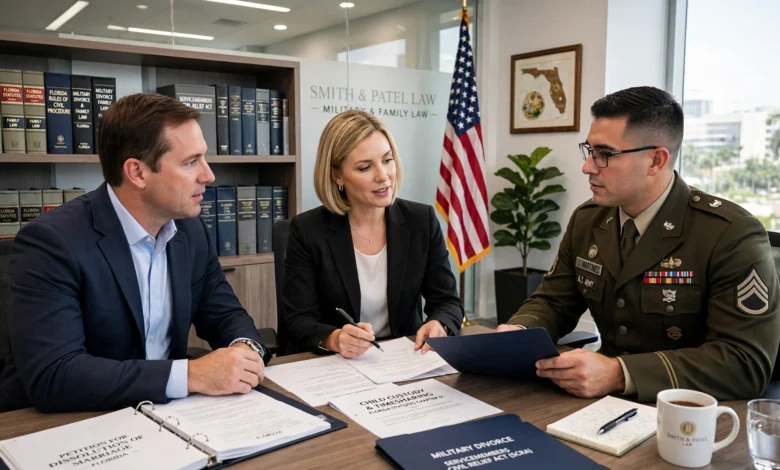
Military divorce in Florida doesn’t work quite like a civilian divorce. Yes, the same Florida family law statutes apply, but there’s a whole layer of federal law sitting on top of them, and it changes how cases get filed, how long they can take, and how assets get divided. If you or your spouse are active duty, in the Reserves, or retired from the armed forces, you’re dealing with rules that a lot of family law attorneys rarely touch and that most spouses have never heard of until they’re in the middle of a divorce.
Deployment schedules can delay hearings. A spouse’s legal residence might not even be Florida, even if the family has lived on base here for years. Military retirement pay isn’t divided the way a regular pension is. And benefits like TRICARE health coverage or the Survivor Benefit Plan can hinge on how long a marriage overlapped with military service, sometimes down to the exact number of years.
This guide walks through the special rules that apply to military divorce in Florida, from residency and jurisdiction to pension division, custody arrangements around deployment, and the benefits that are often overlooked until it’s too late to protect them. Whether you’re the service member or the civilian spouse, understanding these rules upfront can save you months of confusion and thousands of dollars in avoidable mistakes.
Why Military Divorce in Florida Is Different
A civilian divorce in Florida is governed almost entirely by Chapter 61 of the Florida Statutes. A military divorce in Florida adds federal statutes into the mix, most notably the Servicemembers Civil Relief Act (SCRA) and the Uniformed Services Former Spouses’ Protection Act (USFSPA). These laws exist to balance two competing interests: protecting a service member’s ability to focus on their duties without losing legal ground back home, and making sure a former spouse isn’t shortchanged on assets and benefits earned during the marriage.
Florida also happens to be one of the most military-heavy states in the country, home to bases like MacDill, Eglin, Naval Air Station Pensacola, and Naval Station Mayport. Because of that, Florida courts see a steady stream of these cases, and the state has fairly clear procedures for handling them, but the rules still trip people up constantly.
Residency Requirements for Military Divorce in Florida
Under normal Florida divorce rules, at least one spouse has to have lived in the state for six months before filing. For military families, Florida makes an important accommodation:
- A service member stationed in Florida, even if their legal state of residence (also called “home of record” for tax and voting purposes) is somewhere else, can generally file for divorce in Florida as long as they’ve been stationed here for six months.
- A civilian spouse can also file in Florida if they meet the standard residency requirement, regardless of where the service member is stationed.
- Florida courts will look at proof like military orders, a Florida driver’s license, voter registration, or a lease/deed to confirm residency.
This matters because military families move often. A couple might have lived in three states during a five-year marriage, and figuring out where you’re actually allowed to file is one of the first questions a family law attorney will ask.
The Servicemembers Civil Relief Act (SCRA) and Divorce Protections
The Servicemembers Civil Relief Act is a federal law designed to prevent active-duty service members from being disadvantaged in civil legal matters, including divorce, because of their military obligations. It’s one of the most important pieces of federal protection in any military divorce in Florida.
Here’s what it actually does:


- Stays of proceedings. If a service member can show that military duty materially affects their ability to participate in the case, they can request a stay (a pause) of the divorce proceedings, typically for at least 90 days, with the option to request more.
- Default judgment protection. A court can’t enter a default judgment against a service member who doesn’t respond to a divorce filing without first confirming their military status. This stops a spouse from finalizing a divorce while the service member is deployed and unaware of the case.
- Appointment of counsel. If the service member can’t be reached, the court may appoint an attorney to represent their interests before moving forward.
It’s worth being clear about what the SCRA doesn’t do: it doesn’t stop a divorce from happening, and it doesn’t automatically delay every case. It’s a protection against being blindsided, not a permanent shield against divorce itself. Courts also won’t grant an open-ended stay just because someone is in the military; the requesting spouse has to show a genuine conflict with their duties.
For more detail on how these protections work, the Department of Defense’s Military OneSource publishes guidance specifically for service members and families navigating legal issues during divorce.
Jurisdiction: Where to File a Military Divorce in Florida
Jurisdiction questions come up constantly in military divorce cases because families are rarely tied to one address for long. Florida courts can typically exercise jurisdiction if:
- The service member is stationed in Florida and has been for at least six months, or
- The civilian spouse meets Florida’s residency requirement independently.
But filing location also matters for the division of military retirement pay. Under the USFSPA, a state court can only divide military retired pay if it has jurisdiction over the service member based on:
- Their legal residence (not just where they’re stationed),
- Their consent to the court’s jurisdiction, or
- Their residence in the state for reasons other than military assignment.
This means a spouse can sometimes get a divorce finalized in Florida but still run into complications getting the retirement division enforced if the service member’s legal residence is somewhere else and they haven’t consented to Florida’s jurisdiction over that specific issue. This is one of the more technical traps in military divorce, and it’s worth raising directly with an attorney early in the process.
Dividing Military Retirement Pay in a Florida Military Divorce
Military retirement pay is often the single largest asset in a military divorce, and it’s treated differently than a typical 401(k) or civilian pension.
The 10/10 Rule
A common misconception is that a marriage has to last 10 years before a former spouse can get any share of military retired pay. That’s not accurate. What the 10/10 rule actually controls is the method of payment, not eligibility:
- If the marriage overlapped with at least 10 years of creditable military service, the Defense Finance and Accounting Service (DFAS) can pay the former spouse’s share directly, separate from the service member’s payment.
- If the marriage overlapped with less than 10 years of service, the former spouse can still be awarded a share of the pension under Florida law, but the service member is responsible for paying that share directly rather than DFAS splitting the payment.
USFSPA and Disposable Retired Pay
The Uniformed Services Former Spouses’ Protection Act allows state courts to treat military retired pay as marital property, but only the disposable portion, meaning gross retired pay minus certain deductions like disability pay elections. Florida is an equitable distribution state, so the court doesn’t automatically split the pension 50/50. Instead, it divides the marital portion based on what’s fair given the length of the marriage, each spouse’s contributions, and other factors under Chapter 61.
A few practical points worth flagging:
- Only the portion of the pension earned during the marriage is typically subject to division, not pay earned before the marriage or after divorce.
- The order dividing military retirement needs to be drafted carefully and often submitted to DFAS in a specific format to be honored.
- Disability pay is generally not divisible, which sometimes creates disputes when a retiree converts a portion of retired pay into disability compensation after the divorce.
The Department of Defense Finance and Accounting Service publishes detailed rules on how these divisions are processed, and reviewing their official guidance at DFAS.mil can help both spouses understand what documentation the court order needs to include.
Child Custody and Parenting Plans for Military Families
Florida calls custody arrangements “parenting plans” and “time-sharing schedules” rather than custody, but the underlying goal is the same: figuring out what’s in the best interest of the child. Military life adds a layer of complexity that Florida courts have specifically addressed through statute.
Key considerations include:
- Deployment doesn’t permanently change custody. Florida law prohibits using a parent’s military deployment, mobilization, or activation as the sole basis for a permanent change in the parenting plan.
- Temporary time-sharing modifications are allowed during deployment, with the plan reverting once the service member returns, unless both parents agree otherwise.
- Delegation of time-sharing. A deployed parent can, under Florida law, delegate their time-sharing to a family member (like a grandparent) during deployment in some circumstances, subject to court approval.
- Video communication. Courts increasingly include provisions for video calls, texting, or other communication to preserve the parent-child relationship during separation.
Deployment and Custody Modifications
If a deployment is coming up, it’s far better to address it in the initial parenting plan than to scramble for a temporary order once orders are already in hand. A well-drafted plan for a military divorce in Florida will typically include:
- A clear process for temporary schedule adjustments during deployment or training.
- Communication expectations for the deployed parent.
- A default plan for reintegration once the service member returns.
- Language addressing frequent relocations (PCS moves) and how time-sharing adjusts afterward.
Child Support and Alimony in Military Divorce
Florida calculates child support using the same statutory guidelines regardless of military status, based on both parents’ income, the number of overnights, and expenses like healthcare and childcare. The wrinkle in military cases is figuring out what actually counts as income.
For service members, income typically includes:
- Base pay
- Basic Allowance for Housing (BAH)
- Basic Allowance for Subsistence (BAS)
- Special pay (hazard pay, flight pay, etc.)
BAH and BAS are often overlooked because they’re not taxed the same way as base pay, but Florida courts generally do count them as income for support calculations, since they represent real financial benefit to the service member.
For alimony, Florida courts weigh factors like the length of the marriage, each spouse’s earning capacity, standard of living during the marriage, and contributions to the marriage, including time spent supporting a military career through frequent relocations. There’s also a federal cap worth knowing: total child support and alimony combined generally cannot exceed 65% of a service member’s pay and allowances under federal wage garnishment rules.
Health Care and TRICARE Benefits After Divorce
This is one of the areas where former spouses are most often caught off guard. TRICARE eligibility after a military divorce depends heavily on the length of the marriage relative to the service member’s career.
The 20/20/20 Rule
A former spouse keeps full TRICARE benefits (along with commissary and exchange privileges) if all three of these are true:
- The marriage lasted at least 20 years
- The service member had at least 20 years of creditable service
- There’s at least 20 years of overlap between the marriage and the service member’s military service
The 20/20/15 Rule
If the marriage lasted 20 years, the service member had 20 years of service, but there’s only 15 years of overlap, the former spouse can get transitional TRICARE coverage for one year after the divorce, but not permanent benefits.
If a marriage doesn’t meet either threshold, the former spouse generally loses TRICARE eligibility upon divorce, though they may be able to purchase temporary coverage through the Continued Health Care Benefit Program for a limited period.
Survivor Benefit Plan Considerations
The Survivor Benefit Plan (SBP) provides continued income to a designated beneficiary after a retired service member’s death. In a divorce, this often becomes a negotiating point, because without specific court orders and paperwork, a former spouse has no automatic right to remain the SBP beneficiary.
Important points:
- A former spouse SBP election must generally be requested within one year of the divorce being finalized.
- The court order should explicitly state whether the former spouse is to be named as an SBP beneficiary and specify the type of coverage.
- Missing the deadline can permanently forfeit this benefit, so it’s not something to leave until later.
Steps to File for Military Divorce in Florida
While every case is different, a typical military divorce in Florida generally follows this sequence:
- Confirm residency and jurisdiction for both the divorce itself and, separately, for dividing military retirement pay.
- File the initial petition for dissolution of marriage in the appropriate Florida circuit court.
- Serve the service member, following SCRA requirements if they’re on active duty, including confirming military status before any default judgment.
- Address temporary matters, such as interim time-sharing or support, especially if deployment is a factor.
- Exchange financial disclosures, including LES (Leave and Earnings Statements) to establish income and benefits.
- Negotiate or litigate division of assets, retirement pay, custody, support, and benefits like SBP and TRICARE.
- Finalize the judgment, ensuring the order includes the specific language DFAS requires if military retired pay is being divided.
Common Mistakes to Avoid
- Assuming the 10/10 rule determines eligibility for a pension share. It only affects how payment is made, not whether a share is owed.
- Ignoring BAH and BAS when calculating support. These allowances are usually counted as income.
- Missing the one-year SBP election deadline after the divorce is finalized.
- Filing in the wrong jurisdiction for retirement division, which can leave a valid divorce decree unenforceable against DFAS.
- Assuming deployment automatically pauses the entire case. SCRA protections require a showing that military duty actually interferes with participation, not just a general deployment status.
Conclusion
A military divorce in Florida involves the same emotional and financial stakes as any divorce, but with an added layer of federal rules that can significantly change how the case unfolds. From SCRA protections that can pause proceedings during deployment, to the technicalities of dividing military retirement pay under the USFSPA, to benefits like TRICARE and the Survivor Benefit Plan that hinge on specific time thresholds, these cases reward careful attention to detail.
Whether you’re the service member or the civilian spouse, understanding residency rules, jurisdiction requirements, and the deadlines tied to military benefits can make the difference between a fair outcome and one that leaves money or protections on the table. Working with an attorney familiar with both Florida family law and federal military statutes is often the clearest path through it.