How to File for Divorce in California Without a Lawyer: An Honest Guide
Learn how to file for divorce in California without a lawyer, step by step, with real forms, costs, and honest advice on when to get help.
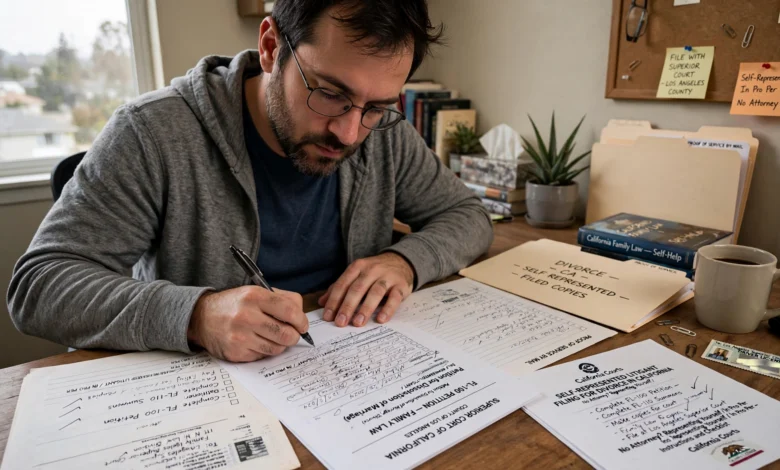
If you’re trying to file for divorce in California without a lawyer, you’re not alone. Thousands of Californians represent themselves in family court every year, mostly because attorney fees can run into the thousands of dollars for even a simple, uncontested case. The good news is that California’s court system was built with self-represented litigants in mind. There are free self-help centers in nearly every county, standardized forms, and clear procedural rules that don’t require a law degree to follow.
That said, going the DIY route isn’t always the right call, and it isn’t always as simple as filling out a form and mailing it in. Mistakes in paperwork, missed deadlines, or a misunderstanding of community property rules can cost you more time and money than hiring help would have in the first place.
This guide walks through the actual process, the forms you’ll need, the fees involved, and the points where most people get stuck. It’s written for people who want a clear-eyed, practical look at what self-representation really involves, not a sales pitch for or against doing it yourself. By the end, you’ll know exactly what steps to take and, just as important, when it might be worth bringing in professional help.
Can You Really File for Divorce in California Without a Lawyer?
Yes. California law does not require you to have an attorney to file for divorce, legally called “dissolution of marriage.” The Judicial Council of California publishes standardized forms specifically so that self-represented parties, often called “pro per” or “pro se” litigants, can complete the process on their own.
That said, self-representation works best when:
- Both spouses agree on the major issues (property division, custody, support)
- There are no complex assets like business interests or multiple properties
- Neither spouse has significant concerns about hidden income or assets
- Both parties are willing to cooperate on paperwork and deadlines
If your situation involves domestic violence, significant asset disputes, or one spouse hiding income, self-representation becomes much riskier, and that’s worth keeping in mind as you read through the steps below.
Step 1: Confirm You Meet California’s Residency Requirements
Before you can file for divorce in California, you or your spouse must meet two residency requirements:
- At least one spouse must have lived in California for the past six months.
- At least one spouse must have lived in the county where you plan to file for the past three months.
If you don’t meet these requirements yet, you can still file for a legal separation in the meantime and later amend it to a divorce once residency is established. This is a detail people often miss, and it can delay a case by months if it’s overlooked at the start.
Step 2: Understand the Difference Between Divorce and Summary Dissolution
Not every case needs the full divorce process. California offers a simplified option called summary dissolution for couples who meet all of the following conditions:


- Married five years or less
- No children together (and not currently pregnant)
- No real estate or property ownership together (with narrow exceptions)
- Combined community property under a set dollar threshold (this amount is adjusted periodically, so check the current figure on the court’s website)
- Both spouses agree to waive spousal support
- Both spouses sign a written settlement agreement
Summary dissolution uses fewer forms and moves faster than a standard divorce. If your marriage was short and uncomplicated, it’s worth checking whether you qualify before diving into the full process.
Step 3: Gather the Right Forms
This is where most self-represented filers either succeed or get overwhelmed. California’s family courts use a defined set of Judicial Council forms, and using the wrong one, or leaving one out, is one of the most common reasons a case gets delayed.
Core Forms You’ll Likely Need
- FL-100 – Petition for Dissolution of Marriage. This starts the case and states what you’re asking for.
- FL-110 – Summons. This notifies your spouse that a case has been filed and outlines automatic restraining orders that go into effect once served.
- FL-105/GC-120 – Declaration Under Uniform Child Custody Jurisdiction and Enforcement Act (only if you have minor children).
- FL-115 – Proof of Service of Summons, used once your spouse has been formally served.
- FL-140, FL-141, FL-142, FL-150 – Declaration of Disclosure and financial forms, required in nearly every case regardless of whether it’s contested.
- FL-180 – Judgment, filed once the case is ready to be finalized.
Optional or Situational Forms
- FL-311 – Child Custody and Visitation Attachment
- FL-300 – Request for Order, used for temporary custody, support, or property orders while the case is pending
- FL-170 – Declaration for Default or Uncontested Dissolution, used when your spouse doesn’t respond or you both agree on terms
Each California county’s Superior Court website typically has a self-help section with checklists specific to that county, since some local rules vary. It’s worth checking your county’s site directly rather than assuming every county handles filing identically.
Step 4: File Your Petition with the Court
Once your forms are complete, you’ll file them with the Superior Court in your county. This involves:
- Making at least two copies of everything (one for you, one for your spouse)
- Paying the filing fee, which is around $435–$450 in most California counties, though this can shift slightly year to year
- Requesting a fee waiver (Form FW-001) if you can’t afford the filing fee, based on income
- Receiving a stamped, filed copy with your case number
Once filed, the court will assign your case a number that you’ll use on every future document. Keep that stamped copy somewhere safe; you’ll need it repeatedly throughout the case.
Step 5: Serve Your Spouse Properly
This step trips up more self-represented filers than almost any other. California law requires that your spouse be formally served with the divorce papers, and you cannot do this yourself.
Service can be done by:
- A friend or family member over 18 who is not a party to the case
- A professional process server
- The county sheriff’s civil division (usually for a fee)
- Certified mail with return receipt, if your spouse agrees to accept service by signing Form FL-117
After service is completed, the person who served the papers must fill out and file Proof of Service (FL-115). Without this document filed correctly, the court won’t move forward with your case, no matter how complete the rest of your paperwork is.
Your spouse then has 30 days to file a Response (Form FL-120). If they don’t respond, you may be able to proceed with a default judgment.
Step 6: Handle Financial Disclosures
Even in an uncontested, friendly divorce, California requires both spouses to exchange financial disclosures. This isn’t optional, and skipping it is one of the most common reasons judges reject a final judgment.
You’ll need to complete:
- FL-142 – Schedule of Assets and Debts
- FL-150 – Income and Expense Declaration
- FL-140 – Declaration of Disclosure (cover sheet)
These documents require you to list bank accounts, retirement funds, real estate, debts, and income in detail. Being thorough here matters. If financial information later turns out to be incomplete or misleading, the entire judgment can be reopened, sometimes years later.
Step 7: Reach an Agreement or Prepare for Trial
If you and your spouse agree on how to divide property, handle custody, and address support, you can submit a Marital Settlement Agreement along with your judgment paperwork. The court reviews it, and if everything is in order, a judge signs off without either of you needing to appear in court.
If you disagree on major issues, your case becomes contested, and you’ll likely need to attend hearings, possibly participate in mediation, and follow a more formal court timeline. This is the point where many people who started the process alone decide to bring in a family law attorney, at least for the contested issues, even if they’ve handled the rest of the paperwork themselves.
California also imposes a mandatory six-month waiting period from the date your spouse is served (or the date they respond) before a divorce can be finalized, regardless of how quickly you both agree on terms.
Common Mistakes People Make When They File for Divorce in California Without a Lawyer
Knowing the forms is only half the battle. Here are the mistakes that come up again and again:
- Skipping financial disclosures because both spouses “already know” what the other owns
- Using outdated forms instead of the current versions from the Judicial Council website
- Missing the 30-day response window, which can complicate default proceedings
- Improper service, including trying to serve papers yourself
- Forgetting to update beneficiary designations on life insurance or retirement accounts after the divorce is final
- Assuming verbal agreements are enough instead of putting settlement terms in writing
- Ignoring the six-month waiting period and expecting a faster resolution
Most of these mistakes aren’t fatal, but they add weeks or months to a process that could otherwise move fairly quickly.
When You Should Still Consult a Lawyer
Filing without an attorney works well for straightforward cases, but there are situations where at least a consultation with a family law attorney is worth the cost:
- One spouse owns a business or has complex income sources
- There’s a significant disparity in income or assets between spouses
- Domestic violence or safety concerns are involved
- Custody is contested or one parent wants to relocate
- Retirement accounts or pensions need to be divided (this often requires a separate legal document called a QDRO)
- Your spouse has hired an attorney and you haven’t
Many family law attorneys in California offer flat-fee “unbundled” services, meaning they’ll review your paperwork or advise you on a specific issue without taking on the full case. This can be a middle ground between full self-representation and hiring an attorney outright.
Helpful Resources for Self-Represented Filers
California has invested in resources specifically for people navigating divorce without an attorney:
- California Courts Self-Help Center: offers free guides, forms, and county-specific instructions for divorce, custody, and support. You can find current forms and filing instructions through the California Courts self-help divorce resources.
- Family Law Facilitator offices: nearly every county courthouse has a facilitator’s office that provides free, neutral help completing forms (though they cannot give legal advice or represent either spouse).
- Legal aid organizations: many counties have nonprofit legal aid groups that offer free or low-cost help for qualifying income levels. The Legal Services Corporation directory can help locate legal aid offices near you.
Taking advantage of these resources, even if you’re handling the case yourself, can catch errors before they become costly.
Conclusion
Choosing to file for divorce in California without a lawyer is a realistic option for many couples, especially when both spouses agree on the terms and the case doesn’t involve complicated assets or custody disputes. The process comes down to confirming residency, filing the right forms, properly serving your spouse, completing financial disclosures, and either reaching a settlement or preparing for a contested hearing, all within California’s mandatory six-month waiting period.
Free resources like county self-help centers and family law facilitators make the process more manageable than most people expect, but the paperwork still demands attention to detail. For simple, cooperative cases, doing it yourself can save thousands of dollars. For anything involving significant assets, custody disputes, or safety concerns, even a single consultation with a family law attorney can prevent costly mistakes down the road.