Forced Marriage Laws in the UK: Protections, Penalties, and Support Resources
Forced marriage is a crime in the UK. Learn the Forced marriage laws in the UK, protection orders, penalties, and where victims can turn for real support.
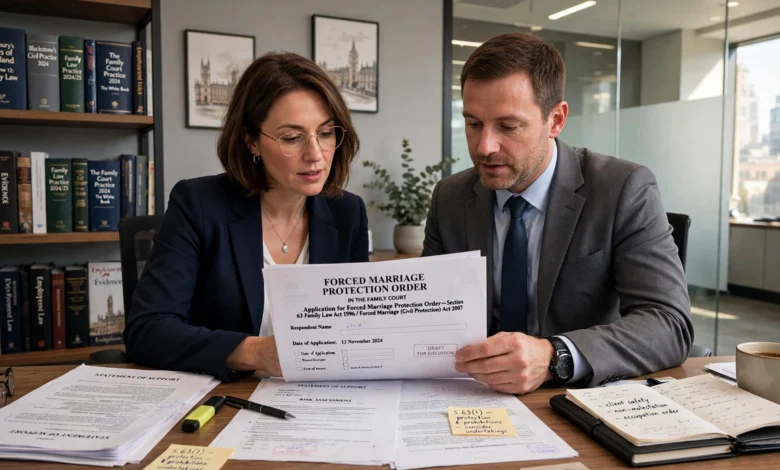
Forced marriage laws in the UK exist to protect people from being pushed, pressured, or threatened into a marriage they never agreed to. It’s a subject that doesn’t get talked about enough, partly because it’s uncomfortable and partly because it often happens behind closed doors, inside families, and away from public view. But the law here is clear and it has real teeth.
Since 2014, forcing someone into marriage has been a criminal offence across England, Wales, and Scotland. On top of that, victims (and people worried about a friend or relative) can apply for a civil order called a Forced Marriage Protection Order, which can stop a wedding before it happens or protect someone after the fact. Northern Ireland has its own version of the same protections.
This article walks through what the law actually says, who counts as protected, what penalties apply to perpetrators, and how the immigration system fits into the picture. It also covers the practical side: who to call, what a Forced Marriage Protection Order can do for you, and which charities and government services are set up specifically to help.
Whether you’re trying to understand your own situation, supporting someone else, or simply researching the topic for professional reasons, this guide lays out the current UK law in plain terms, without the legal jargon that usually gets in the way.
What Counts as Forced Marriage Under UK Law?
The legal definition matters here because it’s broader than most people assume. Under the Family Law Act 1996 (specifically Part 4A, added by the Forced Marriage (Civil Protection) Act 2007), a marriage is considered “forced” if one or both parties haven’t given their free and full consent. The law is explicit that “force” includes not just physical violence, but coercion through threats or other psychological pressure.
That last part is important. A forced marriage doesn’t need to involve a physical struggle or an obvious threat. It can look like:
- Emotional blackmail, guilt-tripping, or being told the family’s honour depends on it
- Being isolated from friends, taken out of school, or having a passport confiscated
- Financial pressure or threats to cut someone off entirely
- Being taken abroad under false pretences and unable to leave
- Direct threats of violence against the person or their loved ones
Forced Marriage vs Arranged Marriage
This distinction trips a lot of people up, so it’s worth being precise. An arranged marriage is one where families help identify and introduce a potential spouse, but both people are free to say no, and both go into it willingly. That’s entirely legal and has been a normal part of many cultures for generations.
A forced marriage is different because consent is missing or compromised. The Crown Prosecution Service and the courts don’t judge the culture or tradition behind a marriage. They look at one thing: whether the person getting married actually wanted to, freely and without pressure. Once consent is taken out of the equation, it becomes a legal matter, no matter how the arrangement was originally framed.
Is Forced Marriage a Criminal Offence in the UK?
Yes, and this is a fairly recent development. For years, the only protection was the civil order system, but campaigners argued that wasn’t enough of a deterrent. That changed with the Anti-social Behaviour, Crime and Policing Act 2014, which created a standalone criminal offence.
England and Wales
Under Section 121 of the 2014 Act, it’s a criminal offence to use violence, threats, or any other form of coercion to force someone into marriage, including a marriage they haven’t consented to because they lack the mental capacity to do so. The offence also covers anyone who deceives a person into leaving the UK with the intent of forcing them to marry abroad.
Following the Marriage and Civil Partnership (Minimum Age) Act 2022, which came into force on 27 February 2023, the law went even further for children. It’s now an offence in England and Wales to carry out any conduct intended to cause a child under 18 to marry, regardless of whether coercion, threats, or deception were used at all. In other words, prosecutors no longer have to prove force was involved when the victim is a child; arranging or facilitating a child’s marriage is enough on its own.
Scotland
Scotland created its own criminal offence and civil protection route through the Forced Marriage etc. (Protection and Jurisdiction) (Scotland) Act 2011, later reinforced by the Anti-social Behaviour, Crime and Policing Act 2014, which extended the criminal offence north of the border. The legal principles mirror those in England and Wales: using coercion to force a marriage is a crime, and courts can issue protection orders.
Northern Ireland
Northern Ireland has its own Forced Marriage (Civil Protection) Act (Northern Ireland) 2013, plus the criminal offence under the 2014 Act. Forced Marriage Protection Orders are available through the Northern Ireland courts in much the same way as in England and Wales.
Forced Marriage Protection Orders (FMPOs)
This is arguably the most practical tool in the entire system, and it’s worth understanding in detail. A Forced Marriage Protection Order is a civil order made by the Family Court under Part 4A of the Family Law Act 1996. It’s designed to be flexible: the court can tailor it to whatever the situation actually requires, rather than working from a fixed template.
Who Can Apply
You don’t have to be the person at risk to apply. The order can be requested by:
- The person who is or may be forced into marriage
- A relevant third party, such as a local authority
- Any other person, with the court’s permission (this covers friends, teachers, or other concerned individuals)
- The court itself, acting on its own initiative during related family proceedings
This matters because victims are often not in a position to seek help themselves. A teacher, social worker, or even a close friend who’s genuinely worried can start the process.
What an FMPO Can Include
Because the order is written to fit the specific circumstances, it can cover a wide range of restrictions and requirements, including:
- Preventing someone from being taken abroad
- Ordering the surrender of passports or travel documents
- Stopping any arrangements for an engagement or wedding ceremony, in the UK or overseas
- Restricting contact between the person at risk and named individuals
- Requiring the respondent to reveal the whereabouts of the protected person
The order can be made against the person doing the pressuring, or against third parties involved in arranging the marriage, including relatives who aren’t the direct perpetrators.
Breaching an FMPO
Since 2014, breaching a Forced Marriage Protection Order is a criminal offence in its own right, carrying a maximum penalty of five years’ imprisonment. Before that change, a breach could only be treated as contempt of court. The government’s own explanatory notes on the 2014 Act make clear the reasoning: relying on contempt of court proceedings meant enforcement was inconsistent, and victims sometimes had to apply separately for an arrest warrant if no power of arrest was attached to the original order. Making breach a standalone criminal offence closed that gap and gave police the power to act immediately.
The Minimum Age of Marriage and Child Protection
For a long time, 16- and 17-year-olds could legally marry in England and Wales with parental or judicial consent. Campaigners had flagged this as a loophole that families could exploit to push a child into marriage while staying technically within the law.
The Marriage and Civil Partnership (Minimum Age) Act 2022 closed that loophole. As of 27 February 2023, nobody under 18 can marry or enter a civil partnership in England and Wales, under any circumstances, including with parental consent. Adults who facilitate or attempt to facilitate the marriage of a child under 18 can now face up to seven years in prison. The change also affects recognition of marriages: if a child domiciled in England or Wales marries abroad, or in Scotland or Northern Ireland, that marriage won’t be legally recognised in England and Wales once they turn 18.
It’s worth noting that Scotland and Northern Ireland haven’t made the same change. In Scotland, 16- and 17-year-olds can still marry without parental consent, and in Northern Ireland, parental consent is still sufficient for that age group. This creates a genuine cross-border gap that child protection groups continue to raise concerns about.
Penalties for Forced Marriage Offences
The penalties attached to UK forced marriage laws vary depending on which specific offence applies:
| Offence | Maximum Penalty |
|---|---|
| Forcing someone into marriage (Section 121, 2014 Act) | Up to 7 years’ imprisonment |
| Conduct causing a child under 18 to marry (post-2023 amendment) | Up to 7 years’ imprisonment |
| Breaching a Forced Marriage Protection Order | Up to 5 years’ imprisonment |
| Related offences (kidnapping, false imprisonment, assault) | Sentencing varies by offence, often run concurrently or consecutively |
Prosecutors will often bring multiple charges alongside the forced marriage offence itself, since cases frequently involve overlapping conduct like false imprisonment, threats, or assault. Sentencing takes into account the age and vulnerability of the victim, the level of coercion used, and whether the perpetrator has a pattern of similar behaviour.
How Immigration Law Intersects With Forced Marriage
Forced marriage cases often have an immigration dimension, and this is one of the areas where the law gets more complicated. Some forced marriages are used specifically to secure a UK visa or settlement for a spouse, which the Home Office treats as a serious aggravating factor. Victims who are on a spousal visa and trying to leave a forced marriage may worry that doing so will affect their immigration status. In practice, the Home Office’s Destitution Domestic Violence (DDV) concession allows some victims on a spousal or partner visa to apply for limited leave to remain with access to public funds, specifically so they can leave an abusive situation without becoming destitute.
Anyone dealing with both a forced marriage and an immigration question should get specialist advice quickly, ideally from an immigration solicitor or a charity that handles both issues together, since visa status and safety decisions often need to be worked out at the same time.
Reporting Forced Marriage: Who to Contact
The Forced Marriage Unit
The Forced Marriage Unit (FMU) is a joint Home Office and Foreign, Commonwealth & Development Office team that leads the government’s response to forced marriage. It runs a public helpline, gives one-to-one advice to people at risk, and can help repatriate British nationals who are trapped in a forced marriage abroad.
According to the government’s most recent published figures, the FMU provided tailored assistance in 406 cases related to a possible forced marriage or FGM in 2025, alongside 889 further enquiries that were signposted elsewhere. The unit’s caseload has consistently shown that a high proportion of those affected are British nationals, which helps counter the misconception that this is purely an issue affecting people from abroad. The FMU also runs training for professionals, including police, local authorities, and border staff, so frontline workers are better equipped to spot warning signs.
Police and Local Authorities
If someone is in immediate danger, calling 999 is the right first step. For situations that aren’t an emergency but still need intervention, local police forces have safeguarding teams trained to handle forced marriage cases, and children’s or adult social services can also open a safeguarding referral. Schools, GPs, and other professionals have a duty to raise concerns if they suspect a child or vulnerable adult is at risk.
Support Resources for Victims and Survivors
Beyond the government’s own services, several UK charities specialise in supporting people affected by forced marriage:
- Karma Nirvana runs a national honour-based abuse helpline and works directly with survivors of forced marriage
- Freedom Charity offers a confidential app and support line aimed particularly at young people at risk
- The Iranian and Kurdish Women’s Rights Organisation (IKWRO) provides specialist support for women from Middle Eastern, Afghan, and North African communities
- National FGM Centre offers combined support where forced marriage and female genital mutilation risk overlap
- Refuge and Women’s Aid both offer broader domestic abuse support that includes forced marriage cases
Many of these organisations offer confidential advice by phone, text, or webchat, which matters a lot for people who can’t safely make a phone call from home.
What to Do If You or Someone You Know Is at Risk
If you’re worried about yourself or someone else, here’s a practical order of steps to think through:
- Get to a safe place first, even temporarily, if a call or meeting isn’t safe to arrange at home
- Contact the Forced Marriage Unit for confidential advice, even if you’re not sure the situation counts as “forced marriage” yet
- Keep important documents accessible, such as a passport or ID, if it’s safe to do so, since these are often confiscated
- Speak to a trusted professional, such as a teacher, GP, or social worker, who has a duty to take safeguarding concerns seriously
- Consider applying for a Forced Marriage Protection Order through the Family Court, either yourself or with a solicitor’s help
- Reach out to a specialist charity like Karma Nirvana for ongoing emotional and practical support, not just a one-off call
None of these steps require you to have already decided what you want to happen. Advice services exist precisely so people can talk through options before committing to any particular course of action.
Recent Data on Forced Marriage in the UK
The scale of the problem is genuinely hard to pin down, since so much of it goes unreported. Still, the government’s published statistics give a useful picture of trends. FMU casework has hovered in the low hundreds each year for over a decade, with 2025 data showing 406 cases receiving tailored assistance. Cases involving British nationals, including dual nationals, remain a consistent and significant share of the total year after year, and the FMU has reported handling cases connected to over 30 different countries outside the UK.
The Home Office has also commissioned academic research, including a joint study by the University of Birmingham and University of Nottingham, specifically to try to estimate how much forced marriage goes unrecorded, which tells you the government itself doesn’t consider the official numbers a complete picture.
Conclusion
Forced marriage laws in the UK have developed significantly over the past two decades, moving from a purely civil remedy to a fully criminalised offence backed by protection orders, a dedicated government unit, and a growing network of specialist charities. Forcing anyone into marriage, whether through violence, threats, or subtler psychological pressure, is illegal across England, Wales, Scotland, and Northern Ireland, and the penalties reflect how seriously the courts treat it.
The 2023 change raising the minimum marriage age to 18 in England and Wales closed one of the more obvious loopholes, though gaps still exist between the UK’s nations. For anyone facing this situation personally, or supporting someone who is, the message from the law and from support organisations is the same: help is available, it’s confidential, and reaching out doesn’t commit you to any particular outcome.