Protecting Children During High-Conflict Divorces in New York
Protecting Children During High-Conflict Divorces in New York: practical, court-tested strategies to shield kids from custody battle harm.
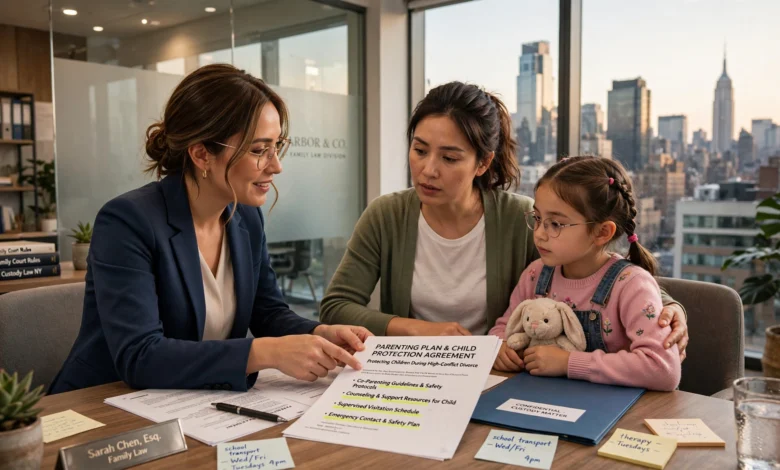
Protecting children during high-conflict divorces in New York starts long before anyone sets foot in a courtroom. It begins the moment a parent decides how they’ll talk about the other parent at the dinner table, whether they’ll hand off custody exchanges calmly, and how much of the legal fight the kids get to see. If you’re going through a high-conflict divorce in New York, you already know the stakes feel higher when children are involved. Every angry text, every missed exchange, every disagreement over a school pickup can turn into ammunition, and the people who end up caught in the crossfire are the ones who never asked to be part of the fight.
This article walks through what New York courts actually look at when parents can’t get along, how child custody in high-conflict cases gets decided, and what you can do right now to keep your kids from carrying the emotional weight of a legal battle they didn’t choose. We’ll cover the legal standards judges apply, the warning signs of parental alienation, the professionals who can help (attorneys for the child, custody evaluators, parenting coordinators), and practical, day-to-day steps that make a measurable difference in how kids cope.
None of this is about winning an argument with your ex. It’s about giving your children the steadiest possible footing while the adults around them sort out something that was never their responsibility to fix.
Understanding What Makes a Divorce “High-Conflict” in New York
Not every contested divorce qualifies as high-conflict. New York family courts and matrimonial attorneys generally look for a pattern, not a single bad day. High-conflict divorce cases in New York tend to share a few recognizable features:
- Frequent, ongoing disputes over custody, parenting time, or major decisions
- Allegations of domestic violence, substance abuse, or neglect
- Repeated violations of court orders or parenting plans
- Difficulty communicating without a third party (attorney, mediator, or app) involved
- One or both parents attempting to limit or control the child’s relationship with the other parent
- Frequent returns to court for modifications or enforcement
If several of these apply to your situation, you’re likely dealing with the kind of case that New York courts treat differently than an amicable, uncontested split. Judges, court-appointed evaluators, and attorneys for children are trained to spot these patterns early, because the research is clear: children in high-conflict divorces face measurably worse outcomes than kids whose parents manage to disagree respectfully.
Why the Distinction Matters for Your Case
Recognizing that your divorce has crossed into high-conflict territory changes the legal strategy. Courts may order forensic custody evaluations, appoint an attorney for the child, or bring in a parenting coordinator to manage disputes outside the courtroom. Understanding this early lets you and your attorney prepare for a longer, more document-heavy process, and it lets you start protecting your children’s daily experience before the court process demands it.
The Legal Standard: New York’s “Best Interests of the Child”
Every custody decision in New York, whether negotiated between parents or decided by a judge, is measured against one standard: the best interests of the child. This isn’t a vague guideline. New York courts, guided by landmark Court of Appeals decisions such as Eschbach v. Eschbach and Friederwitzer v. Friederwitzer, weigh a specific set of factors when parents can’t agree on custody or parenting time.
Judges typically consider:
- Each parent’s ability to provide a stable, nurturing home environment
- The child’s relationship with each parent and any siblings
- Each parent’s willingness to foster a healthy relationship between the child and the other parent
- The mental and physical health of each parent
- Any history of domestic violence, abuse, or neglect
- The child’s own wishes, depending on age and maturity
- The extent and type of conflict between the parents
That last factor is especially important in high-conflict custody cases. A parent who continually undermines the other parent, refuses to communicate, or exposes the child to ongoing hostility can actually damage their own custody position, even if their intentions are good. New York has no automatic presumption in favor of joint custody, and in genuinely high-conflict situations, courts often lean toward awarding one parent decision-making authority precisely because shared decision-making has broken down.


New York courts and legal resources maintain detailed guidance on how these standards apply, and the New York State Unified Court System publishes plain-language explanations of the divorce and custody process that are worth reviewing before your first court date.
How High-Conflict Divorce Affects Children
Before getting into strategy, it helps to understand what’s actually at stake. Protecting children during high-conflict divorces isn’t just a legal talking point, it reflects real, documented developmental risk.
Children exposed to prolonged parental conflict are more likely to experience:
- Anxiety, depression, and difficulty regulating emotions
- Academic struggles and trouble concentrating in school
- Sleep disturbances and physical stress symptoms (stomachaches, headaches)
- Loyalty conflicts, where the child feels pressure to “choose a side”
- Difficulty forming healthy relationships later in life
- Regression in younger children (bedwetting, clinginess, tantrums)
- In more severe cases, symptoms consistent with parental alienation
The American Academy of Child and Adolescent Psychiatry has published extensive guidance on how divorce affects children at different developmental stages, and their materials consistently point to one conclusion: it isn’t the divorce itself that causes the most harm, it’s the ongoing conflict. Parents who can find a way to reduce hostility, even in a legally contentious divorce, give their kids a much better shot at emotional stability. You can review their resources directly on the American Academy of Child and Adolescent Psychiatry website for age-specific guidance on supporting children through separation.
Age-Specific Impact
- Young children (2-6): Struggle most with routine disruption and may regress developmentally
- School-age children (7-12): Often internalize blame or feel responsible for “fixing” the conflict
- Teenagers: May act out, withdraw, or align strongly with one parent, sometimes as a coping mechanism rather than a genuine preference
Understanding where your child falls on this spectrum helps you tailor how much information you share and how you frame the changes happening at home.
Recognizing Parental Alienation
One of the most damaging patterns in a high-conflict custody battle is parental alienation, when one parent, intentionally or not, undermines the child’s relationship with the other parent. New York courts take alienation seriously and can factor it heavily into custody decisions.
Warning signs include:
- A child suddenly refusing contact with a previously loved parent
- Repeating adult-sounding complaints or legal language about the other parent
- One parent badmouthing the other in front of the child or within earshot
- Withholding parenting time, phone calls, or information about school and medical events
- A child expressing guilt about enjoying time with the “targeted” parent
If you suspect this is happening in your case, document specific incidents with dates and details, and raise the concern with your attorney promptly. Courts can order therapeutic intervention, adjust custody arrangements, or appoint a forensic evaluator to assess the family dynamic when alienation is credibly alleged.
Legal Tools New York Courts Use to Protect Children
New York’s family court system has several mechanisms specifically designed to shield kids in contentious cases. Knowing what these are can help you understand what to expect and what to request.
Attorney for the Child (AFC)
In many contested custody cases, the court appoints an Attorney for the Child, an independent lawyer who represents the child’s own legal interests, separate from either parent’s position. The AFC interviews the child, may visit the home, and advocates for what the child wants or needs, depending on their age and maturity. This is one of the most direct protections built into New York’s system for children in high-conflict divorces.
Forensic Custody Evaluations
When conflict is severe, a judge may order a forensic evaluation, typically conducted by a licensed psychologist. The evaluator interviews both parents, the child, and sometimes teachers or other collateral sources, then submits a report with custody recommendations. These evaluations carry significant weight in court and are common in high-conflict New York divorce cases involving allegations of abuse, alienation, or serious parenting deficiencies.
Parenting Coordinators
A parenting coordinator is a neutral professional, often a mental health provider or attorney, appointed to help parents resolve day-to-day disputes without returning to court every time. This can dramatically reduce the number of contentious exchanges children witness, since disagreements get resolved through a structured process rather than heated confrontation.
Supervised Visitation and Exchange Services
In cases involving safety concerns, courts can order supervised visitation or require custody exchanges to happen at a neutral, supervised location. This protects children from witnessing conflict during handoffs, which research consistently shows is one of the most stressful moments for kids in high-conflict families.
Practical Strategies for Protecting Children During High-Conflict Divorces
Legal protections matter, but day-to-day parenting choices matter just as much, often more. Here’s what actually helps.
1. Keep Adult Conflict Away From Kids
This sounds obvious, but it’s the single most protective thing you can do. Protecting children during high-conflict divorces means never using them as messengers, spies, or sounding boards. Practical steps:
- Communicate with the other parent through email, text, or a co-parenting app rather than in person when tensions run high
- Never discuss legal strategy, court dates, or finances within earshot of your kids
- Avoid negative comments about the other parent, even ones that seem minor or offhand
- Save venting for a therapist, friend, or attorney, never your child
2. Maintain Routine and Predictability
Children in high-conflict custody situations cope better when the rest of their world feels stable. Keep bedtimes, school routines, and extracurricular activities as consistent as possible across both households. Predictability is a powerful buffer against the chaos of a contested legal process.
3. Use Neutral Communication Tools
Co-parenting apps like OurFamilyWizard or TalkingParents create a documented, professional communication trail and reduce the temptation to escalate arguments. Courts increasingly recommend or order these tools specifically because they cut down on direct conflict.
4. Get Your Child Their Own Support
A child therapist who specializes in divorce and family transitions gives your child a neutral space to process emotions without feeling caught between parents. This is especially valuable when there’s an Attorney for the Child or custody evaluation involved, since kids often need somewhere to talk that isn’t part of the legal process itself.
5. Don’t Ask Your Child to Choose Sides
Even indirect questions like “Do you want to go to Dad’s this weekend?” can put a child in an impossible position. Let the parenting schedule be an adult decision, communicated to the child as a fact, not a negotiation they’re responsible for.
6. Follow Court Orders Precisely
Violating custody orders, even minor ones, gives the other side ammunition and signals to the court that you may not prioritize stability. Consistent compliance protects your credibility and, more importantly, protects your child from the confusion of inconsistent arrangements.
7. Choose the Right Legal Strategy for Your Family
Litigation isn’t always the only path. Depending on the level of conflict, mediation, collaborative divorce, or a hybrid approach with a parenting coordinator may reduce the adversarial pressure your children experience. An experienced New York matrimonial attorney can help you evaluate which approach fits your specific situation, particularly when safety isn’t a concern but communication has broken down.
Working With the Right Attorney
Not every family law attorney handles high-conflict divorce cases the same way. When interviewing attorneys, ask directly:
- How many high-conflict custody cases have you handled in New York courts?
- Do you have experience working alongside Attorneys for the Child and forensic evaluators?
- What’s your approach to minimizing courtroom exposure for children?
- How do you handle documentation of parental alienation or safety concerns?
A good attorney won’t just fight for a favorable custody outcome, they’ll help you build a record that reflects stability, cooperation where possible, and a genuine focus on your child’s wellbeing. Courts notice which parent is trying to reduce conflict and which parent is escalating it, and that distinction can shape the final custody arrangement significantly.
Red Flags That Warrant Immediate Legal Action
Some situations require faster intervention than a standard custody negotiation. Contact your attorney or, in urgent cases, law enforcement or Child Protective Services, if you observe:
- Physical or emotional abuse
- Substance abuse affecting a parent’s ability to care for the child safely
- A parent attempting to relocate with the child without consent or court approval
- Credible threats of violence
- Signs of severe parental alienation or estrangement
New York courts can issue emergency orders, including temporary custody modifications or orders of protection, when a child’s safety is genuinely at risk. Don’t wait for the next scheduled hearing if you believe your child is in immediate danger.
Building a Co-Parenting Plan That Actually Reduces Conflict
Even in high-conflict New York divorces, a detailed parenting plan can prevent many disputes before they start. Effective plans typically address:
- A specific, written custody and visitation schedule, including holidays and school breaks
- Clear protocols for exchanges (location, time, who’s responsible for transportation)
- Decision-making authority for education, healthcare, and religious upbringing
- Communication expectations (response time, preferred method, emergency contact rules)
- A dispute resolution process, such as mediation or a parenting coordinator, before returning to court
The more specific the plan, the less room there is for the kind of ambiguity that fuels ongoing conflict. Vague language like “reasonable visitation” often becomes a source of repeated disputes; specificity protects both parents and, more importantly, protects the child from the fallout of constant disagreement.
Frequently Asked Questions
Does a child get to choose which parent they live with in New York? There’s no fixed age at which a child’s preference becomes legally binding. Courts consider the child’s wishes as one factor among many, giving more weight to older, more mature children, but the final decision always rests on the overall best interests analysis.
Can a parent lose custody for badmouthing the other parent? Yes. New York courts view a parent’s willingness to foster the child’s relationship with the other parent as a significant factor. Persistent alienating behavior can and does affect custody outcomes.
How long does a high-conflict custody case typically take in New York? It varies widely depending on court backlog, whether a forensic evaluation is ordered, and how many contested issues remain. High-conflict cases involving evaluations and multiple hearings can take a year or more to resolve fully.
Is joint custody still possible in a high-conflict divorce? It’s possible if the specific type of decision-making can be structured to reduce required cooperation (for example, joint legal custody with one parent holding tie-breaking authority on certain issues), but true 50/50 shared decision-making is uncommon when conflict is severe and ongoing.
Conclusion
Protecting children during high-conflict divorces in New York requires understanding both the legal landscape and the everyday choices that shape how kids experience the process. New York courts apply the best interests standard, lean on tools like Attorneys for the Child, forensic evaluations, and parenting coordinators, and weigh how much conflict each parent contributes when making custody decisions. But the legal system can only do so much.
The parents who keep their kids out of the middle, maintain routine and stability, communicate through neutral channels, and get their children the emotional support they need are the ones who give their kids the best chance of coming through a difficult divorce intact. If you’re navigating a high-conflict custody dispute in New York, working with an experienced family law attorney and staying focused on your child’s wellbeing, rather than winning every battle, will serve your family far better in the long run.