Restraining Orders in Florida: How to Get One and What It Covers Legally
Restraining orders in Florida explained: who qualifies, how to file, what protection they offer, and what happens if one is violated.
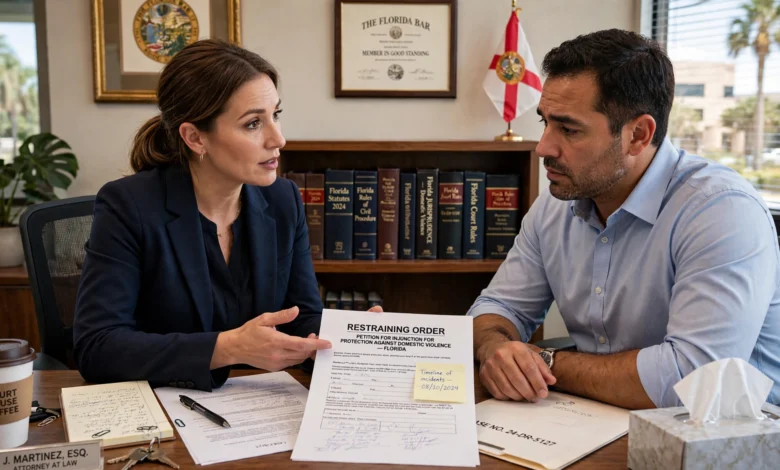
Restraining orders in Florida, legally called injunctions for protection, exist to give people a real, enforceable way to stop someone from contacting or coming near them. If you’re dealing with a partner who won’t leave you alone, a stalker, an abusive family member, or a neighbor who’s crossed a line, Florida law gives you a path to court protection, and it doesn’t cost anything to ask for it. But the process has specific rules, specific categories, and specific proof requirements, and getting it wrong can mean your petition gets denied or delayed at the worst possible time.
This guide walks through everything you need to know about restraining orders in Florida: what they’re actually called under state law, the five types available, who qualifies for each one, how to file a petition, what happens at the hearing, and what a final injunction can and can’t do. We’ll also cover what happens if the other person violates the order, how long protection lasts, and what your rights are if you’re the one being accused. Whether you’re actively in danger right now or just trying to understand your options before you take the next step, this article breaks down the legal reality in plain language, not legal jargon.
If you’re in immediate danger, call 911 first. Everything below is for people who want to understand the civil court process once they’re safe enough to plan their next move.
What Is a Restraining Order in Florida, Legally Speaking?
Florida law doesn’t actually use the term “restraining order” in its statutes. The official legal term is an injunction for protection, and you’ll see that phrase on every court form you fill out. Most people, and most attorneys in casual conversation, still call it a restraining order, so the terms are interchangeable in practice. Whatever you call it, it’s a civil court order, not a criminal charge, meaning the person filing (the petitioner) is asking a judge to legally require the other person (the respondent) to stay away and stop certain behavior.
Because it’s a civil matter, the standard of proof is lower than in a criminal case. You don’t need proof “beyond a reasonable doubt.” You need to show the judge, by a preponderance of the evidence, that you have a reasonable fear and that the legal criteria for the specific injunction type are met.
Here’s what makes Florida’s system worth understanding before you file:
- There’s no filing fee. Petitions for an injunction for protection are filed free of charge in Florida courts, regardless of income.
- You can get emergency protection fast. A judge can review sworn statements the same day and issue a temporary injunction without the other person even being notified first.
- Violating the order is a crime. Breaking a Florida injunction isn’t just a slap on the wrist. It’s typically charged as a first-degree misdemeanor and can lead to arrest on the spot.
- Firearms restrictions apply automatically. Once certain injunctions are in place, the respondent is legally barred from possessing firearms or ammunition.
The Five Types of Injunctions for Protection in Florida
Not every situation qualifies for the same kind of order. Florida law breaks restraining orders into five distinct categories, and picking the right one matters because each has its own legal definition and eligibility rules.
1. Domestic Violence Injunction
This applies when the petitioner and respondent are current or former spouses, related by blood or marriage, currently or previously living together as a family, or share a child together, regardless of whether they were ever married. The underlying conduct has to fit Florida’s legal definition of domestic violence, which includes assault, battery, sexual assault, sexual battery, stalking, kidnapping, false imprisonment, or any criminal offense resulting in injury or death to a family or household member.
2. Dating Violence Injunction
This one is for people who have or had a “significant” and “continuing” romantic or intimate relationship within the last six months, but who never lived together and aren’t related. Florida law looks at factors like how long the relationship lasted, how often the two people interacted, and whether the relationship was ongoing when the incident happened.


3. Sexual Violence Injunction
This is available to victims of sexual battery, lewd or lascivious acts, or other sexual offenses, even when the petitioner and respondent have no prior relationship. Interestingly, this type usually requires that the incident was reported to law enforcement and that the offender was either prosecuted or is still being actively investigated, unless the petitioner has a valid reason for not reporting it.
4. Repeat Violence Injunction
If you don’t have a domestic, dating, or family relationship with the person threatening you, this is often the right category. It requires two separate incidents of violence or stalking, with at least one occurring within six months of filing the petition. A single incident, no matter how serious, generally isn’t enough on its own for this category (though it may qualify under a different type).
5. Stalking Injunction
Florida defines stalking as a pattern, at least two incidents, of willfully, maliciously, and repeatedly following, harassing, or cyberstalking another person. This includes unwanted texts, social media messages, showing up at someone’s home or job, or tracking their location. Cyberstalking specifically covers electronic communication that causes substantial emotional distress and serves no legitimate purpose.
Choosing the correct category isn’t just paperwork. Judges evaluate petitions against the specific legal standard for that injunction type, so filing under the wrong one can weaken an otherwise strong case.
Who Qualifies to File for a Restraining Order in Florida
Eligibility depends heavily on which of the five injunction types applies to your situation, but a few general rules apply across the board:
- You do not need to hire an attorney to file, though having one is strongly recommended for contested cases.
- You do not need to already have a police report, although reporting to law enforcement can strengthen your petition, especially for sexual violence cases.
- You can file on behalf of a minor child if you’re their parent or legal guardian, or on behalf of a vulnerable adult in certain circumstances.
- There is no minimum length of time you need to have known the respondent, except where a specific injunction type requires it (like dating violence).
If you’re unsure which category fits your circumstances, the clerk’s office at your local courthouse can point you to the right form, though clerks generally can’t give legal advice about your odds of success. That’s where a family law attorney becomes valuable, particularly in cases involving custody, shared property, or a respondent who’s likely to fight the petition.
How to Get a Restraining Order in Florida: Step by Step
Filing for an injunction for protection follows a fairly consistent process across Florida’s counties, though small procedural details can vary by circuit. Here’s the general path.
Step 1: Go to the Courthouse and Get the Petition Forms
You’ll file in the circuit court for the county where you live, where the respondent lives, or where the incident occurred. Most Florida counties also let you start the process online through the court’s self-help center, though you’ll typically still need to appear in person for the hearing. The Florida courts system publishes standardized forms for each injunction type, and you’ll want the one matching your specific situation.
Step 2: Fill Out the Petition Completely and Honestly
This is the part that determines whether a judge grants a temporary injunction. Your petition needs to lay out, in your own words and under oath, the specific incidents that led you to seek protection. Vague statements like “he scares me” won’t carry as much weight as detailed accounts with:
- Specific dates and locations of incidents
- Exact words used in threats, when possible
- Any physical injuries and whether they were documented
- Police reports, if any were filed
- Evidence of stalking or harassment, such as text message screenshots or voicemails
- Prior history of violence or threats, including toward pets or children
- Whether the respondent has access to weapons
Judges are looking for a pattern that shows genuine, immediate danger, not just conflict or a bad breakup. Details matter enormously here.
Step 3: A Judge Reviews Your Petition, Often the Same Day
Once you file, a judge reviews the sworn petition, sometimes within hours. If the facts show you’re in immediate danger, the judge can issue a temporary injunction (also called an ex parte injunction because the respondent isn’t present or notified beforehand). This temporary order takes effect as soon as the respondent is served and typically lasts up to 15 days, though courts can extend it if needed.
Step 4: The Respondent Gets Served
Local law enforcement, usually the sheriff’s office, serves the respondent with a copy of the petition and any temporary injunction, along with a notice of the upcoming hearing date. The respondent cannot legally be considered bound by the order until they’ve been served.
Step 5: Attend the Full Hearing
Florida law requires the court to schedule a full hearing, generally within 15 days of the temporary injunction being issued. Both sides get to present evidence and testimony. This is where witnesses, documentation, and, if you have one, an attorney, matter most. The judge decides at this hearing whether to issue a final injunction for protection, which can last anywhere from a fixed number of months to a permanent, indefinite order, depending on the facts of the case.
What a Restraining Order in Florida Actually Covers
A final injunction for protection isn’t just a piece of paper telling someone to stay away. Florida law allows judges to include a range of specific protective terms, and the exact provisions depend on the type of injunction and the facts of the case. Common provisions include:
- No-contact requirements, barring the respondent from calling, texting, emailing, messaging on social media, or contacting the petitioner through a third party
- Stay-away distance requirements, often 100 to 500 feet, from the petitioner’s home, workplace, school, or vehicle
- Firearm surrender, requiring the respondent to relinquish any weapons and prohibiting new purchases while the order is active
- Temporary custody and timesharing provisions, if children are involved, which can include supervised visitation or a complete suspension of contact
- Exclusive use of a shared residence, allowing the petitioner to remain in a home even if the respondent’s name is also on the lease or deed
- Financial support orders, in domestic violence cases, requiring the respondent to continue certain support payments
- Pet protection, allowing the petitioner to keep custody of shared pets
A judge tailors these provisions to what’s actually needed for safety. Not every injunction includes every provision above; the court fits the order to the facts presented at the hearing.
How Long Does a Florida Restraining Order Last?
This depends on the type of order and the judge’s assessment:
- A temporary injunction generally lasts up to 15 days, or until the full hearing takes place.
- A final injunction can be issued for a set period, extended, or made permanent with no expiration date, depending entirely on the judge’s evaluation of ongoing risk.
- Either party can petition the court later to modify or dissolve the injunction if circumstances change substantially.
According to WomensLaw.org, <cite index=”2-1″>Florida automatically considers two types of injunctions when a domestic violence petition is filed: a temporary, ex parte injunction and a final injunction for protection.</cite> That two-stage structure is what allows for fast emergency protection followed by a more thorough hearing later.
What Happens If Someone Violates a Restraining Order in Florida
Violating an active injunction in Florida is a criminal offense, not just a civil technicality. Depending on the conduct involved, a violation is generally charged as a first-degree misdemeanor, punishable by up to a year in jail and a fine. If the violation involves an act of violence, repeated violations, or use of a weapon, prosecutors can pursue enhanced charges.
Law enforcement can arrest a respondent on the spot for violating a restraining order, without needing a warrant, if there’s probable cause the order was broken. Common violations include:
- Showing up at the petitioner’s home, workplace, or school
- Sending texts, emails, or social media messages
- Contacting the petitioner through a third party, like a mutual friend or family member
- Following or surveilling the petitioner
- Possessing a firearm despite the injunction’s restrictions
If you’re a petitioner and the respondent violates the order, call law enforcement immediately and document what happened, screenshots, timestamps, witness names, anything that helps establish the violation for the report.
If You’ve Been Served: Defending Against a Florida Injunction
Being served with a petition doesn’t mean you’re automatically guilty of anything. You have the right to appear at the hearing, present your own evidence, call witnesses, and cross-examine the petitioner. Some petitions genuinely reflect legitimate safety concerns; others get filed as leverage in a custody dispute or a messy breakup. If you believe the allegations against you are false or exaggerated, courts generally expect you to:
- Attend every scheduled hearing, missing one can result in an injunction being granted by default
- Bring documentation that contradicts the claims, texts, emails, alibi witnesses, or anything relevant
- Avoid contacting the petitioner in any way while the temporary order is active, even to “clear things up”
- Consider hiring a family law attorney, especially if custody or firearms are involved
A final injunction can affect employment, professional licensing, custody arrangements, and firearm rights, so contesting an unwarranted petition is worth taking seriously.
Restraining Orders and Child Custody in Florida
When children are part of the picture, a domestic violence injunction can significantly shape custody and timesharing outcomes. Florida courts are required by statute to consider evidence of domestic violence when determining a parenting plan’s best-interest factors. That doesn’t mean an injunction automatically strips someone of custody, but it is one factor among several the court weighs, and it can lead to supervised visitation, restricted communication, or temporary suspension of timesharing while the underlying issues are resolved.
For the full statutory language governing how these petitions are filed and evaluated, Florida’s official statutes are available through the Florida Legislature’s website, which lays out the exact requirements for a petition for injunction for protection against domestic violence.
Enforcing a Florida Restraining Order Across State Lines
Under federal law, a valid injunction issued in Florida is enforceable in every other U.S. state, and the reverse is also true for orders issued elsewhere and brought into Florida. If you move, or the respondent does, you don’t lose protection. It’s worth carrying a certified copy of the order with you and registering it with local law enforcement in your new location if you relocate, since that can speed up enforcement if a violation occurs.
Frequently Overlooked Details About Florida Restraining Orders
A few practical points people often miss when they’re going through this process for the first time:
- You can request a temporary injunction without notifying the respondent first. This is intentional, so the person isn’t tipped off before they’re served.
- There’s no cost to file, appeal, or modify most injunctions in Florida, which removes a financial barrier that exists in some other states.
- You don’t have to already be separated or divorced to file a domestic violence injunction against a spouse.
- A criminal case and a civil injunction can run in parallel. Filing for an injunction doesn’t replace a criminal complaint, and pursuing one doesn’t prevent the other.
- Injunctions can include protection for family members, not just the petitioner, if they’re also at risk.
Conclusion
Restraining orders in Florida, officially known as injunctions for protection, give people facing domestic violence, dating violence, sexual violence, repeat violence, or stalking a free and relatively fast legal path to safety. The process runs through five distinct injunction categories, each with its own eligibility rules, and moves from an emergency temporary order to a full court hearing where a judge decides whether to issue lasting protection.
A final injunction can cover no-contact terms, distance requirements, firearm surrender, custody arrangements, and more, and violating one carries real criminal consequences. Whether you’re seeking protection or responding to a petition filed against you, understanding how the process works, what evidence matters, and what the order can legally require puts you in a far stronger position to protect your safety, your rights, or both.