Virtual Visitation Rights in Illinois: How Courts Handle Long-Distance Parenting
Virtual visitation rights in Illinois help long-distance parents stay connected to their kids through video calls under court-ordered terms.
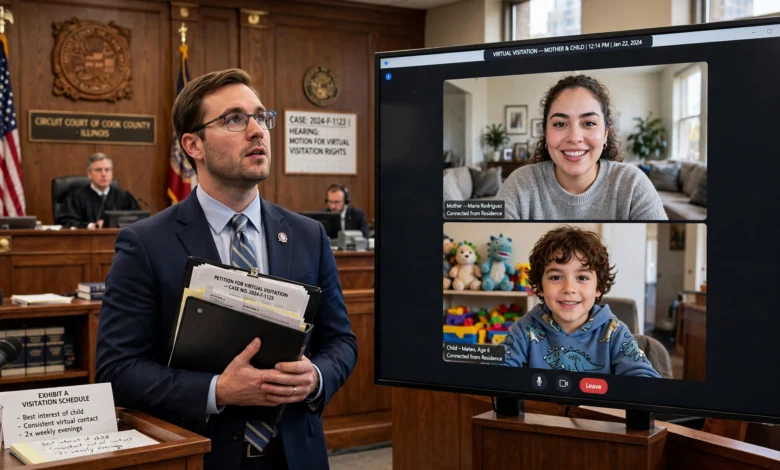
Virtual visitation rights in Illinois have become a real fixture of Illinois family law, not a footnote. When one parent moves out of state for a job, a new relationship, or family support, the other parent doesn’t lose their place in the child’s life just because the miles add up. Illinois courts recognize that a phone call or a video chat can’t replace a hug, but it can keep a bond alive between the weekends or the summer visits.
If you’re a parent facing a relocation, whether you’re the one moving or the one staying behind, you’ve probably already started asking how visitation actually works when your child lives three states away. This article walks through how Illinois defines virtual visitation, what the law actually says about electronic communication as part of parenting time, how judges decide these cases, and what a workable long-distance parenting plan tends to look like in practice.
Illinois doesn’t use the term “custody” anymore. Since 2016, the law talks about parental responsibilities and parenting time instead, and virtual visitation fits inside that framework as a supplement to in-person time, not a replacement for it. Courts lean on the same “best interests of the child” standard they use for every other parenting decision, and that standard shapes everything from how often video calls happen to which app the parents are required to use.
Below, we’ll break down the legal basis for virtual visitation in Illinois, how relocation cases affect it, what judges look for when approving a long-distance parenting plan, and practical tips for making it work once the order is in place.
What Is Virtual Visitation, Exactly?
Virtual visitation refers to the use of technology, video calls, phone calls, texting, email, and similar tools, to allow a parent and child to interact when they can’t be in the same room. Think Zoom calls before bedtime, FaceTime during a school project, or a quick voice message on the way to soccer practice.
It’s important to understand that virtual visitation isn’t a separate legal category in Illinois. It falls under the broader term electronic communication, which the state’s family law statute treats as an extension of parenting time rather than a stand-alone right. That distinction matters because it means a court won’t order virtual visitation in isolation. It gets folded into the larger parenting time schedule and spelled out in the parenting plan.
Common forms of virtual visitation include:
- Scheduled video calls (FaceTime, Zoom, Skype, Google Meet)
- Phone calls at set times during the week
- Text messages or photo/video sharing apps
- Shared online calendars or co-parenting apps like OurFamilyWizard or Talking Parents
- Email updates on school, medical, or extracurricular matters
None of these tools are mandated by law. Instead, Illinois courts have discretion to decide what fits the family’s situation, and that flexibility is both the upside and the challenge of virtual visitation cases.
The Legal Basis for Virtual Visitation in Illinois
Illinois addresses this topic directly in the Illinois Marriage and Dissolution of Marriage Act. Under 750 ILCS 5/602.7, which governs the allocation of parenting time, the law states that visitation may include electronic communication under conditions and at times determined by the court. That single sentence is the backbone of every virtual visitation order in the state.


A few things stand out about how the statute is written:
- Electronic communication is discretionary, not automatic. The law says a court “may” allow it, not that it must. Judges decide case by case whether virtual visitation makes sense.
- It supplements, not substitutes. The statute frames electronic communication as something added to in-person parenting time when circumstances call for it, particularly when distance makes frequent in-person visits impractical.
- Conditions and timing are court-controlled. A judge can specify exactly when calls happen, how long they last, and what platform is used, which is why parenting plans involving long-distance families often read like a schedule rather than a general statement of rights.
For the full statutory language, the Illinois General Assembly’s compiled statutes are the authoritative source, and family law attorneys frequently cite this section when drafting long-distance parenting plans.
How This Differs From Standard Parenting Time
Standard parenting time under Illinois law assumes both parents live close enough to share physical custody on a regular rotation, weekdays, weekends, holidays, and so on. Long-distance parenting, by contrast, usually compresses in-person time into blocks, think extended summer stays, alternating school breaks, or every-other-month weekend trips, and fills the gaps with virtual contact.
The court’s job in these cases is to make sure the child still experiences consistent contact with both parents, even if the format changes. A judge isn’t going to treat a video call the same as a Saturday at the park, but they will recognize it as meaningful contact worth protecting in a court order.
When Does Virtual Visitation Come Into Play?
Virtual visitation typically becomes a topic in a few recurring scenarios:
- Parental relocation. One parent wants to move out of state (or a significant distance within Illinois) for work, family, or personal reasons, and the case involves a formal relocation petition.
- Military deployment. A parent serving in the military may need a temporary virtual visitation arrangement while stationed away from home.
- Initial custody determinations involving distant parents. Sometimes parents already live far apart when a parenting plan is first created, whether due to a prior long-distance relationship or a parent moving before litigation begins.
- Modification requests. An existing parenting plan may be modified to add or adjust virtual visitation terms if circumstances change, such as a parent’s new job requiring travel.
Relocation Cases and Virtual Visitation
Relocation is where virtual visitation shows up most often in Illinois courts. Under 750 ILCS 5/609.2, a parent who wants to relocate with a child, meaning move more than 25 miles for those in Cook, DuPage, Kane, Lake, McHenry, or Will counties, or more than 50 miles elsewhere in Illinois, or any distance outside the state, generally needs either the other parent’s written consent or court approval.
When a judge reviews a relocation request, they weigh factors such as:
- The reasons for the move and the reasons against it
- The educational opportunities available to the child at the new location
- The child’s ties to the current community, school, and extended family
- The feasibility of maintaining a meaningful relationship between the child and the non-relocating parent through a revised parenting time schedule
- Whether the child’s wishes should be considered, depending on age and maturity
That fourth factor is exactly where virtual visitation enters the conversation. Courts often approve a relocation on the condition that the parenting plan includes a robust virtual visitation schedule to offset the reduction in in-person time. In some cases, judges have denied relocation requests specifically because the proposed plan didn’t do enough to preserve the child’s relationship with the parent left behind.
How Illinois Courts Decide Virtual Visitation Terms
Every decision involving parenting time, including virtual visitation, comes back to the best interests of the child standard under 750 ILCS 5/602.7. This is the same test judges use for allocating parenting time generally, and it includes factors like the child’s wishes, the child’s adjustment to home and school, each parent’s willingness to cooperate, and the distance between the parents’ homes.
When a court is specifically shaping a virtual visitation order, judges tend to focus on a narrower set of practical questions:
1. Age and Developmental Needs of the Child
A toddler and a teenager experience video calls very differently. Judges often factor in whether the child is old enough to sit through a meaningful call, whether they need a caregiver present to facilitate it, and how virtual contact might need to evolve as the child gets older.
2. Access to Technology
Not every household has reliable internet, a working webcam, or a private space for calls. Courts may require the custodial parent to provide reasonable access to a device and internet connection at agreed times, and they may specify backup options like phone calls if video isn’t available.
3. Frequency and Timing
Parenting plans typically nail down specifics: two video calls per week, 20 minutes each, at 6:30 p.m. Central time, for example. Vague language like “reasonable virtual contact” tends to invite disputes, so courts and attorneys generally push for clear, enforceable terms.
4. Parental Cooperation
Judges pay close attention to whether the custodial parent is likely to actually facilitate the calls. A history of withholding contact, screening calls, or discouraging communication with the other parent can work against a parent’s credibility in relocation and parenting time disputes.
5. Privacy and Supervision
In cases involving safety concerns, a court might require virtual visitation to be supervised or recorded, similar to how in-person supervised visitation works. This is less common but does come up in high-conflict cases.
What a Long-Distance Parenting Plan Typically Includes
A well-drafted parenting plan addressing long-distance arrangements usually goes well beyond “the parents will facilitate video calls.” Courts and attorneys tend to favor specificity because vague terms are hard to enforce. A thorough plan often covers:
- Scheduled call times, including day of week, time, and duration
- Backup arrangements if a call is missed due to illness, travel, or technical issues, and how make-up time is handled
- Approved platforms, so both parents know whether it’s FaceTime, Zoom, or a specific co-parenting app
- Who initiates the call, meaning whether the long-distance parent calls in or the custodial parent sets it up
- Rules about privacy, such as the custodial parent not listening in or interrupting the call unless there’s a safety concern
- Provisions for special occasions, like birthdays, holidays, or first days of school, where extra virtual contact might be appropriate
- In-person visitation schedule, since virtual visitation is meant to supplement, not replace, actual physical time together
Sample Structure of a Virtual Visitation Clause
Attorneys often draft language along these lines (adapted for illustration, not a substitute for an actual court order):
- The non-residential parent shall have video contact with the child every Tuesday and Friday from 6:00 p.m. to 6:30 p.m. Central Time.
- The residential parent shall ensure the child has access to a functioning device and stable internet connection at the scheduled time.
- If a scheduled call is missed due to circumstances beyond either parent’s control, the parents shall reschedule within 48 hours.
- Neither parent shall record calls without the other’s knowledge, absent a court order permitting it.
- This provision shall be reviewed and may be modified as the child’s needs and schedule change with age.
Enforcement: What Happens If Virtual Visitation Is Denied?
Once a court order includes virtual visitation terms, it carries the same weight as any other parenting time provision. If a parent repeatedly blocks scheduled calls, cancels them without cause, or otherwise interferes, the other parent has legal options under 750 ILCS 5/607.5, Illinois’s parenting time enforcement statute.
Under that law, a parent can file an enforcement action, and the court is required to handle it on an expedited basis, since missed parenting time (including virtual contact, when it’s part of the order) can’t be undone after the fact. If the court finds a violation, it has a range of remedies available, including:
- Ordering make-up parenting time or make-up virtual contact
- Modifying the existing parenting time schedule
- Holding the non-complying parent in contempt of court
- Imposing a civil fine per incident of denied contact
- Requiring reimbursement of attorney’s fees and costs
- In more serious or repeated cases, suspending the non-complying parent’s driving privileges or imposing probation-like conditions
Courts generally require the violating parent to pay the other parent’s reasonable attorney’s fees and costs, except when there’s good cause not to. That fee-shifting provision is one reason denied virtual visitation gets taken seriously rather than dismissed as a minor scheduling issue.
For more detail on how these enforcement provisions work, the Illinois Compiled Statutes on parenting time enforcement lay out the specific remedies available to a parent whose virtual visitation rights are being ignored.
Common Challenges With Virtual Visitation Orders
Even with a clear court order, long-distance parenting through virtual visitation comes with friction points that families run into again and again:
- Time zone mismatches, especially when the moving parent relocates across the country or internationally
- Technology gaps, such as a young child not having independent access to a device
- Gatekeeping behavior, where the custodial parent limits or discourages calls without technically violating the letter of the order
- Call quality issues that disrupt the emotional flow of a conversation, particularly with younger children who lose patience quickly
- Sibling dynamics, when multiple children are sharing limited call time and it becomes hard to give each child individual attention
None of these issues are usually grounds for a court to strike down virtual visitation altogether, but they’re often the basis for modification requests when the original schedule stops working.
Tips for Making Virtual Visitation Actually Work
Parents navigating a long-distance parenting arrangement tend to have better outcomes when they treat virtual visitation as a genuine part of the relationship rather than a legal box to check. A few practices that tend to help:
- Keep calls predictable. Kids do better with routine, so sticking to the same days and times matters more than the length of any single call.
- Let the child lead sometimes. Not every call needs to be an interview. Watching a show together remotely or doing homework “together” over video can feel more natural than forced conversation.
- Document communication through a co-parenting app. Apps built for this purpose create a record that can be useful if disputes arise later.
- Be flexible around the child’s schedule, not just the parents’. A call scheduled during a sports practice or right after a long school day usually won’t go well.
- Revisit the plan as the child grows. What works for a six-year-old rarely works the same way for a fourteen-year-old, and Illinois courts are generally open to modifying virtual visitation terms as circumstances change.
When to Talk to a Family Law Attorney
Virtual visitation disputes often arise alongside bigger issues, relocation requests, modification petitions, or enforcement actions, and the stakes for a child’s relationship with a parent are high enough that DIY approaches can backfire. An Illinois family law attorney can help draft enforceable language, represent a parent in a relocation hearing, or file an enforcement action if calls are being blocked. Given how fact-specific these cases are, getting terms in writing early tends to prevent much bigger conflicts down the road.
Conclusion
Virtual visitation rights in Illinois give long-distance parents a legally recognized way to stay connected to their children when in-person time isn’t possible often enough. While the law treats electronic communication as a supplement to parenting time rather than a stand-alone right, courts take it seriously, both when approving relocation requests and when enforcing existing orders. A well-written parenting plan that spells out call frequency, platforms, and backup arrangements gives families the best shot at making virtual visitation work in practice, not just on paper.
And when a parent blocks or interferes with court-ordered virtual contact, Illinois law provides real remedies, from make-up time to fee-shifting to contempt findings. For parents navigating a move, a deployment, or any situation that puts distance between them and their kids, understanding how these rules work is the first step toward protecting that relationship.