Military Deployment and Child Custody in Georgia: What Parents Need to Know
Military deployment and child custody in Georgia raise urgent legal questions for service members. Here's what every parent needs to know.
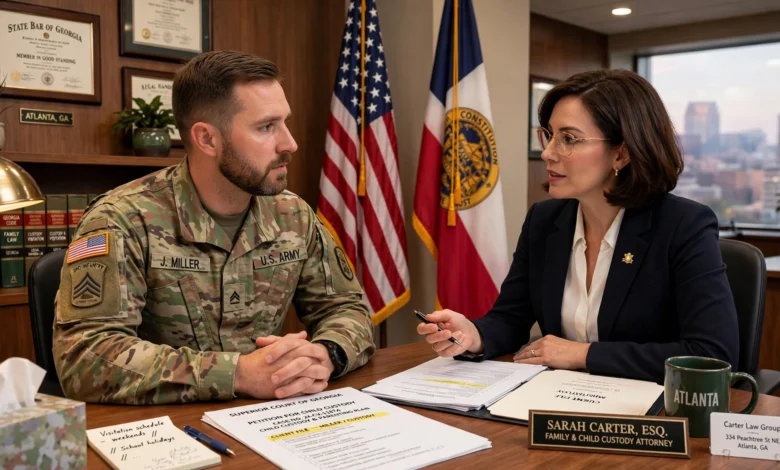
Few things weigh on a service member’s mind more than what happens to their kids while they’re gone. Military deployment and child custody in Georgia intersect in ways that surprise a lot of parents, especially if they assume a deployment order automatically puts their custody rights on hold. It doesn’t work that way, and Georgia has actually built specific legal protections into its family law code to make sure deploying parents aren’t penalized for serving their country.
Still, the rules are detailed, and getting them wrong can cost a parent time with their child. Between the Georgia Military Parents Rights Act, federal protections under the Servicemembers Civil Relief Act, and jurisdiction questions that come up when families move between states, there’s a lot for a military parent to track. Add the emotional stress of an upcoming deployment on top of a pending divorce or custody dispute, and it’s easy to feel overwhelmed.
This article breaks down what Georgia law actually says about deployment and custody, what protections deployed parents have, what a Family Care Plan needs to include, and what steps to take before orders come down. Whether you’re active duty, a National Guard member, or the co-parent of someone who’s about to deploy, understanding these rules ahead of time makes the whole process far less stressful.
1. Georgia Has Specific Laws Protecting Deployed Parents
Georgia doesn’t leave military families to figure out custody questions on their own. The state passed the Georgia Military Parents Rights Act, which amended O.C.G.A. § 19-9-3 to add protections specifically for deploying and deployed parents. Before this law existed, some parents found that time spent away on military duty was used against them in custody disputes, with the other parent arguing that deployments made them a less reliable caregiver. The Act was designed to close that gap.
Under the current version of the statute, a parent’s absences caused by deployment, or even the potential for future deployment, cannot be treated as the deciding factor in denying, restricting, or modifying custody. That doesn’t mean military service is irrelevant to a case. It means judges can’t use deployment alone as grounds to take away parental rights or responsibilities.
How the Law Defines “Deployment”
Georgia’s family code, under O.C.G.A. § 19-9-6, is specific about what counts as deployment for legal purposes. It generally covers military service performed under official orders that require a parent to report unaccompanied by family, including:
- Combat operations
- Contingency or peacekeeping operations
- Remote tours of duty
- Temporary duty assignments
- Mobilization periods
The deployment period also legally extends through any time the service member remains subject to those orders, including delays caused by illness, injury, leave, or other lawful reasons. That matters because it determines when certain custody protections kick in and when they expire.
2. Courts Cannot Rush a Final Custody Order During Deployment
One of the most practical protections in Georgia law is the 90-day rule. Under O.C.G.A. § 19-9-3(i), a court is barred from entering a final order that modifies parental rights and responsibilities earlier than 90 days after a deployment ends, unless the deployed parent agrees to it.
This exists for an obvious reason: it’s nearly impossible for a deployed parent to meaningfully participate in a custody hearing, gather evidence, or coordinate with an attorney while stationed overseas or in a restricted environment. The 90-day buffer gives that parent time to settle back in, review the situation, and actually take part in the legal process rather than have permanent decisions made without them.


This protection is one reason child custody in Georgia cases involving military parents often move at a different pace than typical custody disputes. Attorneys familiar with these cases build the deployment timeline into their strategy from the start.
3. Temporary Modifications Keep the Peace During Deployment
While a final order can wait, Georgia law does allow for temporary custody modifications so a deployed parent stays connected to their child during their absence. Once a service member receives formal notice from military leadership that deployment is coming, either parent can petition the court to establish or modify a temporary parenting plan.
These temporary orders are meant to bridge the gap until the deploying parent returns, not to permanently redefine the custody arrangement. A temporary plan typically addresses:
- Who has physical custody of the child during the deployment period
- How visitation or contact will work if a designated caregiver (like a grandparent) steps in
- How the deployed parent will maintain communication, whether by video call, phone, or other electronic means
- What happens if deployment dates shift, since military schedules are rarely fixed
Georgia law specifically recognizes that departure and leave dates can change with little notice due to military necessity, and it prohibits the nondeploying parent from using those schedule changes as an excuse to block contact between the deployed parent and the child.
4. The Predeployment Parenting Plan Gets Legal Priority
Here’s a protection that surprises a lot of military parents in a good way. Once deployment ends, Georgia law creates a legal presumption that the custody arrangement in place before the deployment still serves the child’s best interests, and that it should resume once the service member returns.
If the nondeploying parent wants to permanently change that predeployment plan, the burden falls on them to prove the situation has changed enough that the old arrangement no longer works. In other words, the deployed parent doesn’t have to fight to get their original custody rights back; the other parent has to justify why those rights shouldn’t be restored.
This presumption is a meaningful safeguard against a scenario military families worry about constantly: coming home from deployment to find custody has quietly shifted in their absence. According to a fact sheet published by the Staff Judge Advocate at Fort Benning, this provision is one of the strongest protections Georgia offers compared to federal law alone <cite index=”6-1″>since it makes it harder for a parent who received temporary custody during deployment to keep it once the deployed parent returns</cite>.
5. Federal Protections Add Another Layer: The SCRA
Georgia’s state-level protections work alongside federal law, specifically the Servicemembers Civil Relief Act (SCRA). The SCRA allows active-duty service members to request a stay, or postponement, of civil court proceedings, including custody hearings, if their military duties materially affect their ability to participate.
This means a deploying or deployed parent isn’t forced to choose between showing up to a hearing and fulfilling military orders. If deployment makes it impossible to appear, the SCRA gives a legal basis to request more time. Georgia law reinforces this by allowing deployed parents to present testimony and other evidence through electronic means when their deployment materially affects their ability to appear in person.
Together, the SCRA and Georgia’s own statutes create overlapping protections, but they work a little differently. The SCRA is about delaying proceedings; Georgia’s law is more about shaping what those proceedings can and can’t decide once they happen. Knowing both is important, because relying on just one can leave gaps in a parent’s defense.
6. Family Care Plans Matter More Than Most Parents Realize
Every branch of the military requires service members with dependents to maintain a Family Care Plan, a document outlining who will care for a child during deployment if the other parent is unavailable, unwilling, or unable. Georgia’s custody statute references these plans directly.
Under Georgia law, any court order takes priority as the first course of action for a child’s care during a parent’s absence. The Family Care Plan only becomes the operative arrangement if the nondeploying parent either refuses to provide care or acknowledges they can’t reasonably do so. Importantly, a deployed parent who implements their Family Care Plan in good faith, because the other parent refused or couldn’t handle care, cannot be held in contempt of an existing court order for doing so.
A strong Family Care Plan should typically include:
- A designated short-term guardian, often a grandparent, sibling, or close family friend, who can step in immediately
- A designated long-term guardian, in case the deployment extends or circumstances change
- Financial arrangements, including how the caregiver will be supported
- Medical and school authorization documents, so the caregiver can make necessary decisions
- Communication plans, so the deployed parent stays informed
Keeping this plan updated, and making sure the other parent and the court both know it exists, can prevent a lot of confusion if deployment orders come down quickly.
7. Jurisdiction Questions Can Complicate Military Custody Cases
Military families move often, and that mobility creates its own legal wrinkle. Which state has authority over a custody case when a family has lived in multiple states, or when one parent is stationed elsewhere? This is governed by the Uniform Child Custody Jurisdiction and Enforcement Act (UCCJEA), which Georgia has adopted.
Generally, the state that issued the original custody order keeps jurisdiction unless both parents and the child have permanently left that state. This matters a great deal for military families because a permanent change of station doesn’t automatically transfer a custody case to the new state. Parents sometimes assume that moving to a new duty station means starting over legally, but that’s usually not true unless very specific conditions are met.
Because jurisdiction disputes can drag on and create real uncertainty for a child’s living situation, it’s worth confirming jurisdiction status early, ideally before a move, rather than after a dispute has already started.
Steps Military Parents Should Take Before Deploying
Preparing early makes an enormous difference if a custody dispute arises later. Parents facing an upcoming deployment should consider taking these steps as soon as orders are confirmed:
- Update or create a Family Care Plan and make sure it aligns with any existing custody order.
- Request a temporary parenting plan through the court if one isn’t already in place, especially if there’s tension with the other parent.
- Document communication with the other parent about caregiving arrangements, in writing where possible.
- Consult a Georgia family law attorney familiar with military custody cases before deployment begins, not after a dispute starts.
- Keep copies of deployment orders, since these documents are often required as evidence in custody proceedings.
- Set up a reliable way to stay in contact with the child during deployment, and get it written into any temporary order.
- Understand the timeline, including the 90-day rule, so there are no surprises about when a final custody decision can be made.
Common Mistakes Military Parents Make in Custody Disputes
Even well-prepared parents can trip over avoidable mistakes. Some of the most common ones include:
- Assuming deployment automatically means losing custody, which simply isn’t how Georgia law works
- Waiting until deployment orders arrive to start the legal process, instead of planning months in advance
- Failing to formally document a Family Care Plan, leaving it as an informal understanding instead of something the court can rely on
- Not requesting a temporary parenting plan, which leaves custody arrangements vague during a critical period
- Assuming a permanent change of station transfers jurisdiction automatically
- Ignoring communication requirements, which can later be used to argue the deployed parent wasn’t engaged with the child
Avoiding these missteps often comes down to timing. The earlier a military parent addresses custody questions, the more control they retain over the outcome.
When to Talk to a Family Law Attorney
Custody law involving deployment is a fairly narrow legal specialty, and not every family law attorney handles it regularly. If a service member is facing deployment while a custody case is open, or expects one might open while they’re away, it’s worth finding an attorney with direct experience in military custody cases in Georgia. According to guidance published by Justia’s legal resource library, the statute has been amended multiple times in recent years, most recently in 2022, so working with someone who tracks current law matters more than it might for a more static area of family law.
An attorney can help draft a Family Care Plan that actually holds up in court, request a temporary parenting plan before orders are finalized, and make sure a deployed parent’s rights are protected the moment they’re notified of deployment, not after they’ve already left.
Conclusion
Military deployment and child custody in Georgia don’t have to be a source of constant anxiety, but they do require preparation. Georgia has built real protections into its family law code, from the 90-day rule that prevents rushed final orders, to the presumption favoring a predeployment parenting plan, to provisions that keep a Family Care Plan legally recognized when it’s needed most. Federal protections under the SCRA add another layer of support, and the UCCJEA helps clarify jurisdiction when a military family has lived in more than one state.
The parents who come out of these situations with the least stress are usually the ones who plan ahead, keep documentation current, and bring in legal help before a dispute forces their hand. Deployment is hard enough without also worrying about losing time with your child, and Georgia law was written specifically to make sure that worry doesn’t have to become reality.