Same-Sex Divorce in Melbourne: Legal Process and Common Challenges
Same-sex divorce in Melbourne follows the same Family Law Act process as any marriage, but couples still face a few unique hurdles.
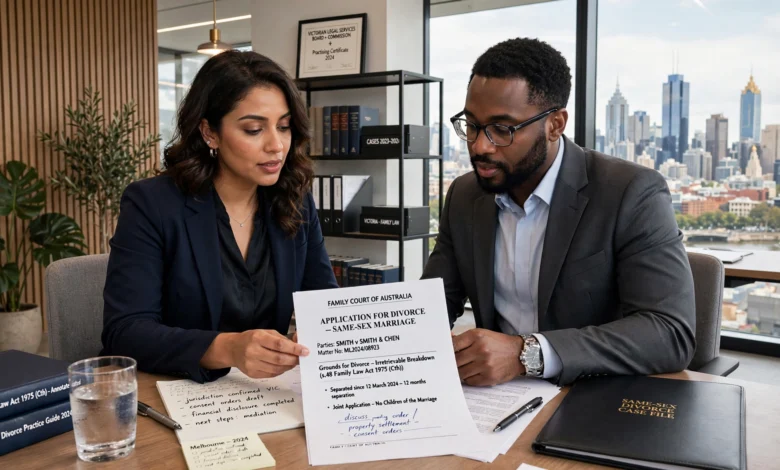
Same-sex divorce in Melbourne works exactly the same way, legally speaking, as any other divorce in Australia. Since marriage equality became law in December 2017, married same-sex couples have had access to the identical process that opposite-sex couples use under the Family Law Act 1975. That said, “the same on paper” doesn’t always mean “the same in practice.” Same-sex couples going through divorce in Melbourne often run into a few sticking points that heterosexual couples rarely think about, from proving legal parentage of children to dealing with a lawyer or mediator who simply doesn’t understand their relationship history.
This article walks through the full legal process for same-sex divorce in Melbourne, step by step, and then digs into the practical challenges that tend to catch people off guard. Whether you were married in Australia or overseas, whether you have kids or a jointly owned property, or whether this is simply an amicable, no-fuss separation, you’ll find a clear roadmap here. We’ll cover eligibility rules, the 12-month separation requirement, court filing steps, costs, property settlement, parenting arrangements, and where to find LGBTQIA+-informed legal support in Melbourne. By the end, you should have a solid, practical understanding of what to expect and how to avoid the most common mistakes people make when filing.
What Same-Sex Divorce in Melbourne Actually Means Under the Law
Before marriage equality passed in 2017, same-sex couples in Australia had no legal pathway to divorce because they had no legal pathway to marriage in the first place. Many were left relying on de facto relationship law instead, which is a different (and in some ways weaker) legal framework. That’s no longer the case. Once same-sex marriage was legalised, the Family Law Act 1975 was automatically extended to cover same-sex married couples, and it hasn’t required a separate set of rules since.
In practical terms, this means a same-sex divorce in Melbourne is processed through the exact same court, using the exact same forms, and judged against the exact same criteria as any other divorce. The court doesn’t ask about the gender of either party, and it has no separate track for same-sex applications. The Federal Circuit and Family Court of Australia handles all divorce applications nationally, including every application filed in Victoria.
There is one nuance worth knowing. If your marriage took place overseas, for example in a country that legalised same-sex marriage before Australia did, that marriage is generally recognised here as long as it was valid in the country where it happened and doesn’t fall foul of specific exclusions in the Marriage Act. This matters because a lot of same-sex couples married overseas during the years before Australian marriage equality, then later needed to divorce here.
Eligibility Requirements for Same-Sex Divorce in Melbourne
To apply for a same-sex divorce in Melbourne, you need to meet three basic conditions. These aren’t unique to same-sex couples, but they’re worth spelling out clearly because missing one of them is the single most common reason applications get delayed or rejected.
The 12-Month Separation Rule
Australia runs on a no-fault divorce system. You don’t need to prove wrongdoing, blame, or misconduct. All you need to show is that the marriage has broken down irretrievably, and the way the court measures that is through a mandatory separation period of at least 12 months and one day before you file. If you and your spouse got back together at any point during that 12 months for more than a brief reconciliation attempt (generally under three months), the clock resets.
You can be separated while still living under the same roof, which is common in Melbourne given the cost of renting or buying a second property. If that applies to you, you’ll need to file an additional affidavit explaining how the separation was managed practically, such as sleeping arrangements, shared finances, and whether you told friends or family.
Residency and Citizenship Requirements
At least one spouse must fall into one of these categories:


- An Australian citizen by birth, descent, or grant of citizenship
- Ordinarily a resident of Australia and has been for the 12 months immediately before filing
- A permanent resident of Australia at the time of filing
You don’t both need to meet this requirement, and you don’t need to still be living in Australia. Plenty of people who’ve since moved overseas file for divorce in Melbourne because that’s where the marriage was registered or where they last resided.
Same-Sex Marriages Performed Overseas
If you married overseas before Australia legalised same-sex marriage, or you’re an Australian couple who married in Canada, the UK, the US, or another country that recognised same-sex marriage earlier, your marriage is almost always recognised here. You’ll still need to provide your original marriage certificate (or a certified translation, if applicable) when you file. This is one area where a same-sex divorce lawyer can genuinely save you time, since foreign marriage certificates sometimes trip up the court’s document checks in ways an Australian certificate wouldn’t.
Step-by-Step Legal Process for Same-Sex Divorce in Melbourne
Here’s the practical, step-by-step version of how a same-sex divorce in Melbourne actually plays out from start to finish.
Step 1: Confirm Eligibility and Gather Documents
Before you file anything, pull together your marriage certificate, both parties’ full legal names (and any prior names, since the court checks these against the marriage certificate), and proof of separation if you’re relying on a same-address separation. If children under 18 are involved, you’ll also need their details for the mandatory parenting section of the application.
Step 2: Choose a Sole or Joint Application
You can file:
- A sole application, where only one spouse applies. This requires formally serving the other spouse with the divorce papers.
- A joint application, where both spouses apply together. This is usually faster and doesn’t require formal service, since both parties have already agreed to the divorce.
For couples on reasonably good terms, a joint application is almost always the simpler and cheaper route. It also tends to feel less adversarial, which matters when you’re trying to keep things civil, especially if you’ll still be co-parenting or sharing a friend group afterwards.
Step 3: File With the Federal Circuit and Family Court of Australia
Applications are filed online through the Commonwealth Courts Portal, which covers the whole of Australia including Victoria. Melbourne doesn’t have its own separate divorce registry system; everything runs through the same national digital process. You’ll pay the court filing fee at this point (more on cost below), upload your documents, and submit the application electronically.
Step 4: Serve the Divorce Application (Sole Applications Only)
If you filed alone, your former spouse must be formally served with a copy of the application, usually by post, email (if the court has approved this method), or in person through a process server. Proper service matters a lot here. If the court isn’t satisfied the other party was properly notified, your hearing date can be pushed back or the application can be dismissed outright.
Step 5: Attend Court (If Required)
Most divorce applications in Australia don’t require either party to physically appear in court. You’ll only need to attend if:
- You filed a sole application and there are children under 18 involved, or
- There’s a dispute about whether the marriage has actually broken down, or
- The court has specific questions about your paperwork
Joint applications with no children rarely require a court appearance at all.
Step 6: Receive the Divorce Order
If everything checks out, the court grants a divorce order at the hearing (or without a hearing, for straightforward joint applications). The order becomes final one month and one day after it’s made. At that point, you’re legally divorced, and you can request a certified copy of the divorce order if you need it for things like updating your name, remarrying, or dealing with superannuation and estate matters.
How Much Does Same-Sex Divorce in Melbourne Cost?
The cost of a same-sex divorce in Melbourne is identical to any other divorce, since the court fee is a flat national fee set by the federal government, not something that varies by state or by the nature of the relationship.
As of 2026, the standard filing fee is $1,125, with a reduced fee of $375 available if you hold an eligible concession card or can demonstrate financial hardship. This is the only cost you’re legally required to pay if you’re filing the divorce application yourself without a lawyer.
Beyond the court fee, your total cost depends on a few things:
- Using a lawyer for a straightforward divorce: typically an extra $1,200 to $1,500 for a fixed-fee service
- Property settlement negotiations: anywhere from a few thousand dollars for an agreed consent order to tens of thousands if the matter is contested
- Parenting disputes: these can become the most expensive part of the process if you and your ex-spouse can’t agree on arrangements
It’s worth remembering that the divorce itself, meaning the legal end of the marriage, is usually the cheapest and most straightforward part. Property settlement and parenting arrangements are separate legal processes and tend to cost far more if they’re contested.
Common Challenges Faced During Same-Sex Divorce in Melbourne
This is where same-sex divorce in Melbourne starts to diverge a bit from the standard experience, even though the legal process is identical on paper. None of these challenges show up in the Family Law Act itself, but they show up regularly in real cases.
Parenting and Legal Parentage Disputes
For couples who used assisted reproduction, surrogacy, or adoption to have children, working out legal parentage can get complicated fast, especially if one partner isn’t the biological or adoptive parent. Australian family law doesn’t automatically assume parentage is only biological. If you’ve been actively involved in raising a child and sharing parental responsibility, you may still have rights to custody, contact, or a say in major decisions, but this often needs to be formally established rather than assumed. This is one of the areas where getting advice from a family lawyer early, ideally before separation even happens, makes a real difference.
Property Settlement and Financial Complexities
Property settlement after a same-sex divorce in Melbourne follows the same legal test as any divorce: the court looks at financial and non-financial contributions from both parties, the length of the relationship (which usually includes time spent living together before marriage, not just the marriage itself), and future needs such as earning capacity, age, and health. Same-sex couples sometimes face extra wrinkles here, particularly if the relationship began well before same-sex marriage was legal, meaning years of de facto contribution need to be factored into a settlement that technically only covers the marriage period.
Lack of LGBTQIA+-Informed Support
This one isn’t a legal issue so much as a practical one, but it comes up constantly. Not every family lawyer, mediator, or court-appointed counsellor has direct experience working with same-sex couples, and a lack of familiarity can show up as small but frustrating friction, like assumptions about who the “primary” parent is, or forms and processes that weren’t originally designed with same-sex families in mind. Melbourne has a growing number of LGBTQIA+-specialist family lawyers and mediators, and it’s usually worth seeking one out rather than defaulting to whichever firm is closest or cheapest.
Overseas Marriage Recognition Issues
Couples who married overseas before Australian marriage equality sometimes hit administrative snags when the court needs to verify a foreign marriage certificate, particularly if it’s in a language other than English or from a jurisdiction the Australian court system deals with less frequently. This is usually solvable with a certified translation and a bit of patience, but it can add a few weeks to the process.
Social and Family Dynamics
Divorce is emotionally difficult for anyone, but same-sex couples sometimes navigate an added layer: family members who weren’t fully supportive of the marriage in the first place, a smaller or more interconnected social circle where “everyone knows everyone,” or the emotional weight of ending a relationship that took real effort and risk to formalise in the years before marriage equality existed. None of this changes the legal process, but it’s a real part of what makes same-sex divorce in Melbourne feel different in practice, even when it looks identical on the court forms.
Property Settlement After Same-Sex Divorce in Melbourne
Divorce and property settlement are two separate legal processes in Australia, and this trips people up constantly. Getting a divorce order does not automatically divide your assets. If you want the court to formally approve how property is split, whether that’s the family home, superannuation, savings, or debts, you need to apply separately for a property settlement, usually through consent orders if you both agree, or through court proceedings if you don’t.
There’s a strict time limit here that’s easy to miss: you generally have 12 months from the date your divorce becomes final to apply for property settlement or spousal maintenance. Miss that window, and you’ll need the court’s special permission to apply late, which isn’t guaranteed. This is one of the most important practical details of the whole process, and it’s worth marking in your calendar the day your divorce order comes through.
The court’s approach to dividing property doesn’t distinguish between same-sex and opposite-sex marriages. It looks at:
- What each person brought into the relationship financially
- What each person contributed during the relationship, including non-financial contributions like homemaking or raising children
- What each person’s future needs look like, taking into account age, health, income, and care of any children
Parenting Arrangements and Children After Same-Sex Divorce
If children are involved, parenting arrangements are handled separately from the divorce itself, and the court’s guiding principle is always the “best interests of the child,” regardless of the parents’ sexual orientation or gender identity. Same-sex parents have exactly the same standing to apply for parenting orders as any other parent, whether that’s about living arrangements, time spent with each parent, or decision-making responsibility for things like schooling and medical care.
Where things can get more complex is establishing legal parentage in the first place, particularly for a non-biological or non-adoptive parent. If this applies to your situation, it’s worth getting advice on parentage before you even start the divorce process, since it can affect what orders you’re eligible to seek.
Do You Need a Family Lawyer for Same-Sex Divorce in Melbourne?
Technically, no. You can file for divorce entirely on your own, and if it’s a straightforward joint application with no property or parenting disputes, plenty of couples do exactly that. The Federal Circuit and Family Court of Australia‘s online system is designed to be usable without legal assistance for the divorce application itself.
That said, a lawyer becomes genuinely useful in a few specific situations:
- Your marriage happened overseas and involves foreign documentation
- You need to sort out property settlement or spousal maintenance
- There are parenting arrangements to work out, especially around legal parentage
- One party is contesting the divorce or won’t cooperate with service
- You want a binding financial agreement or consent orders drawn up properly so they hold up later
If any of those apply, look specifically for a same-sex divorce lawyer or family law firm with genuine LGBTQIA+ experience rather than one that simply lists it as a service line on their website. The difference in how your case is handled, and how comfortable the process feels, can be significant.
Tips to Make Same-Sex Divorce in Melbourne Easier
A few practical things that consistently make the process smoother:
- File jointly if you can. It’s cheaper, faster, and avoids the formal service requirement entirely.
- Sort out property and parenting matters separately, but don’t ignore the deadlines. The 12-month window for property settlement starts ticking the moment your divorce is finalised.
- Get your documents in order early, especially an overseas marriage certificate, since translation and verification can take time.
- Consider mediation before litigation. It’s almost always cheaper and less stressful than going to court over property or parenting disputes.
- Look for LGBTQIA+-experienced legal support, particularly if you have children or a complex financial situation.
- Keep records of your separation date and circumstances, especially if you were separated under one roof, since you’ll need to explain this in an affidavit.
Frequently Asked Questions
Is same-sex divorce in Melbourne handled differently to opposite-sex divorce? No. The legal process, court, forms, fees, and eligibility criteria are exactly the same under the Family Law Act 1975.
Can I get divorced in Melbourne if I married overseas? Yes, as long as your marriage is recognised under Australian law and you meet the standard residency and separation requirements.
How long does a same-sex divorce in Melbourne take? Most straightforward applications take around three to four months from filing to the divorce order becoming final, assuming there are no complications with service or documentation.
Do I need a lawyer to file for divorce? No, but legal advice is strongly recommended if property, parenting, or overseas documentation is involved.
What happens to our shared property? Property isn’t automatically divided by the divorce order. You need to apply separately for property settlement, generally within 12 months of your divorce becoming final.
Conclusion
Same-sex divorce in Melbourne runs on the same legal framework as any other divorce in Australia: the same 12-month separation rule, the same Federal Circuit and Family Court of Australia process, the same filing fees, and the same principles for dividing property and arranging care for children.
Where things get genuinely different is in the practical details, from establishing legal parentage for non-biological parents, to navigating overseas marriage documentation, to simply finding a lawyer or mediator who understands your relationship without needing it explained. Knowing the process in advance, meeting the eligibility requirements, filing jointly where possible, and getting the right legal support for your specific situation will make the whole experience far less stressful, and put you in a much stronger position to move forward.